A theme that exists because of one plugin
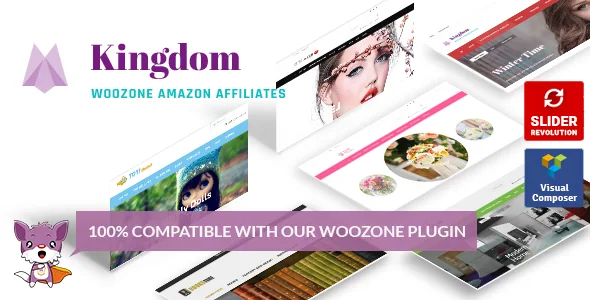
Kingdom's own WordPress theme description states the premise without hedging: it is "built exclusive for our WZone - WooCommerce Amazon Affiliates Plugin," and AA-Team says it deliberately skipped the extra features other multipurpose themes carry. That sentence decides what to judge the theme by. The work you are paying for is how Amazon-sourced product data appears on the page, not how flexibly the theme handles categories of physical stock you ship yourself.
The vendor's framing of the workflow is equally narrow: build a WooCommerce store, fill it with Amazon products as an affiliate, earn advertising fees. If your catalog arrives from a different importer, or you sell your own inventory, the WZone-specific treatments described below are dead weight. If it does arrive from WZone, those treatments are the reason the theme exists.
The three WZone display surfaces the vendor names
Among its compatibility claims, the vendor singles out what it calls custom design work for WZone output: products inside posts, related products, and the country availability box. Those are the placements a generic WooCommerce theme usually leaves to default templates.
The in-post product box is the one that shapes editorial decisions. It lets a review or buying guide carry a product call-out between paragraphs instead of sending readers to the shop archive, so your articles can do the recommending while the box supplies the product imagery and price. Related products cover the suggestions below a product page, and the country availability box is Amazon-affiliate specific: it shows where an item can be bought, which is information a standard WooCommerce template has no field for.
The vendor also lists custom cart and checkout design. Treat that as a styling claim about the affiliate flow, and look at how the flow behaves with your own WZone setup before you count on it.
Shop toggles that decide how much Amazon data shows
The Customizer collects the shop controls in one place: products per page, and show/hide switches for the star rating, the details or general description, the product description tab, product categories and product tags.
For an affiliate catalog these are editorial choices rather than styling preferences. Ratings pulled from Amazon reflect a different audience than your own site, so hiding them is a defensible default. Category and tag links on a thin archive add navigation that leads nowhere useful. A long imported description can swamp the page if the description tab is left open. Because the switches are grouped, you can settle those decisions once rather than editing templates per section.
The surrounding settings are ordinary but complete: top bar content, logo, header social links, fonts with size, weight, colour and spacing controls, sharing icons, primary and secondary colours, menu background, widget areas, copyright text, a partners or clients carousel switch, payment icon links, and a footer sidebar that can be disabled.
Two editing routes, and why picking one early matters
The vendor announced Gutenberg support for the theme and lists the Gutemplate plugin as part of the package, with Kingdom-specific templates for assembling page elements. The marketplace attribute records Gutenberg Optimized as Yes.
A second route sits alongside it. The vendor states the theme is bundled with Visual Composer and Slider Revolution, and mentions a growing library of Revolution Slider and Visual Composer templates as a bonus. Both routes are described as first-class, which means the choice is yours and the upkeep is yours too: pages built in Visual Composer and pages built with blocks do not share a layout language, and a site mixing them for no reason becomes harder to hand over. Decide which editor your pages will use, then keep templates consistent with that decision.
The vendor also names a Premium SEO Pack plugin and Convert Plus for popups among the included plugin set, and describes dummy sites importable through a Backup Manager plugin. Those are the seller's claims about its own package; whether a given copy you obtain carries the same plugins, and whether any of them need separate licence keys, is a separate question to settle before you build around them.
Device-specific display modes
The layout is declared responsive and retina ready, which is table stakes. The more particular claim is three individually customisable display modes, one for desktops and laptops, one for tablets and one for phones, described as a per-device presentation rather than a single fluid design that reflows.
That has a practical use on affiliate pages, where a product box with a large image and a price block can crowd a phone screen. If the modes work as described, you can trim what the box shows on smaller devices instead of letting it compress. Sidebars and footer widgets are customised through the Customizer, and the footer sidebar can be switched off when a page does not need it.
Declared versions and what the dates imply
Marketplace attributes record compatibility with WooCommerce 7.x, 6.x and 5.x, and with WordPress 6.2.x, 6.1.x, 6.0.x, 5.9.x and 5.8.x. The marketplace also lists the latest theme version as 4.2, with a vendor update dated 6 October 2023, and files typed as PHP, CSS and JavaScript. Gutenberg Optimized is recorded as Yes, the theme is widget ready, and the browser list runs from IE11 through Chrome, Firefox, Safari, Opera and Edge.
Those are declarations from the vendor and the listing, not results from testing on your server. The update date is worth weighing: a theme whose last recorded vendor update is from 2023 and whose declared ceiling is WordPress 6.2.x has not published support for the releases that followed. That does not prove it breaks on a newer version, but it does mean you would be running an untested combination. Confirm the current state with the vendor and walk the product boxes, country box and checkout through on staging with the exact WordPress, WooCommerce and WZone versions you intend to run.
Translation readiness and WPML compatibility are also vendor statements, which matters if you target more than one Amazon marketplace.
Questions & answers
Can I use Kingdom without the WZone plugin?
The vendor positions Kingdom as a theme built specifically for the WZone WooCommerce Amazon Affiliates plugin, and its distinctive display work is aimed at WZone output: product boxes in posts, related products and the country availability box. Nothing in the supplied listing promises a general-purpose shop design for catalogs from other plugins or for inventory you fulfil yourself. Without WZone, the theme's main reason to exist does not apply.
Does the theme work on WordPress versions released after 6.2?
The compatibility field observed on 3 November 2026 tops out at WordPress 6.2.x, and the last recorded vendor update is from October 2023. Nothing in the supplied evidence declares support beyond that range. Running a newer WordPress release is not proven to fail, but it is an untested combination, so confirm the vendor's current position and test the shop, product boxes and checkout on staging first.