Four content types, four single templates
The page list published by the vendor names Services and Service single, Projects and Project single, Case studies and Case study single, and Careers with Career single. Four listings, four detail layouts. For a manufacturer, plant operator or engineering contractor those are genuinely different pieces of writing: a capability you sell, a job you delivered, a documented outcome for a client, and an open role.
Most corporate themes collapse that into a services page plus a portfolio. When a case study and a project share one template, one of them ends up forced into the other's layout — a result statement sitting where a photo gallery belongs, or the reverse. Here the split is already made for you.
The same page list adds a Team page with individual team member profiles, a Gallery in three layouts, and an FAQ page, which covers the company-side content without extra plugin work.
Ten home layouts, and how the roster grew
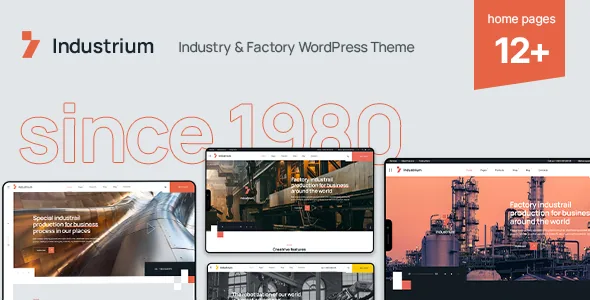
The starter set is named per sub-sector rather than as colour variants of one demo: Home Industry, Factory, Robotics, Manufacture, Engineering, Metallurgy, Architecture, Plant, Oil industry and Shop. The changelog shows how they arrived. Version 1.1 added Construction, Metal works and Renewable energy; version 1.2 added Architecture, Plant, Oil industry and Shop.
Ten options create a small choosing problem, because several will share the same underlying structure. The difference between Industry and Factory, or Manufacturing and Engineering, is more likely to be photography and tone than a different information architecture. Pick the demo whose sections match the material you can actually supply — photography, specifications, plant imagery — then rewrite the copy. Choosing on visual polish first tends to reveal a layout that depends on assets you don't have.
According to the vendor, a one-click demo import brings the chosen layout's pages in. How much of a given demo the import reproduces is worth confirming on a test install.
Elementor edits the pages, and the theme is patched around it
Elementor is the editing layer: the vendor calls it an intuitive live page builder, and the marketplace compatibility field lists it. A theme-specific plugin is updated in step with the theme, and the changelog records what that pairing costs to maintain. Version 1.5.3 carries a layout compatibility fix for Elementor 3.25.0. Version 1.5.2 fixed a case where Elementor 3.24.0 broke scripts for the search bar and sidebar.
Those entries are the useful part if you plan a site that lives for years: a theme that styles Elementor widgets is exposed whenever the builder changes its markup, and this record shows patches made in response. Version 1.5.7 fixed section-control styles inside the Elementor editor, and an earlier release stopped theme button styles leaking into Elementor's own service buttons.
The marketplace attribute also marks Gutenberg optimization as Yes, which means the block editor is available for ordinary posts and pages while the marketing pages are assembled in Elementor. It does not mean both editors render the same output.
Shop templates that were kept current
WooCommerce shows up in two places: a Shop home layout with product list, single product, cart and checkout pages, and a compatibility field declaring WooCommerce 6.x through 9.x. The changelog is more informative than the field, because it shows the templates being revised. Version 1.5.6 updated the cart template to WooCommerce 10.1.0. Version 1.5.4 updated the account login form to 9.9.0 and removed obsolete code that could stop new customers registering.
For an industrial supplier the store is usually a parts and equipment catalogue, so the product list and single product templates matter more than the cart styling. If items carry datasheet links, part numbers or long specifications, look at how a product detail page is laid out before committing — the vendor's feature list does not describe specification fields.
Forms work through WPForms or Contact Form 7, both of which appear in the compatibility record, with a WPForms modern-styles fix recorded in version 1.4.0. Either is a reasonable base for a quote or enquiry form.
Sliders follow the site language, not a toggle
The feature list includes RTL Ready and the compatibility record lists WPML. One changelog entry changes how that behaves in practice: version 1.5.4 removed the manual RTL settings in sliders, so they now switch to RTL mode automatically. On a right-to-left site there is one less switch to set per slider, but direction follows the site language rather than a per-slider choice.
The same release reworked textdomain loading so theme and plugin strings register at the init event, and refreshed the language files. That is the sort of plumbing you notice only when plugin strings fail to appear in your translation workflow.
Layered PSDs in the package
The marketplace file list names PHP files, Layered PSD and PSD, and the feature list claims 30+ customizable PSD files. That is an unusual inclusion for Elementor theme work and it changes one specific handoff: a designer can adapt a layout in Photoshop and pass over a layered file that the builder can reproduce, instead of redrawing from screenshots.
If no designer is involved in your project, the PSDs do nothing for the live site. They earn their place when a home page or campaign section has to be mocked up before anyone touches Elementor.
The feature, page and update details here come from the vendor's marketplace description and changelog as observed on 4 November 2026, not from a hands-on install of the theme. The declared WordPress range (6.0.x through 7.0.x) and the WooCommerce ceiling of 9.x sit alongside changelog entries from later releases, so test your own WordPress and WooCommerce combination on staging before launch.
Questions & answers
Does Industrium need WooCommerce?
No. The theme lists WooCommerce as a supported plugin and ships shop templates plus a Shop home layout, but the industry, factory and sector layouts work on their own, so a site without a store is a normal use.
Can the demo pages be rebuilt in Gutenberg instead of Elementor?
The block editor is available for posts and pages and the theme is marked Gutenberg optimized. The starter layouts and demo content are built in Elementor, so reproducing a demo page in blocks means rebuilding it rather than importing it.
Do the RTL sliders still have a manual direction setting?
No. Version 1.5.4 removed the per-slider RTL settings, and sliders now switch to RTL mode automatically based on the site language.