The layout decision happens on the page, not in a builder
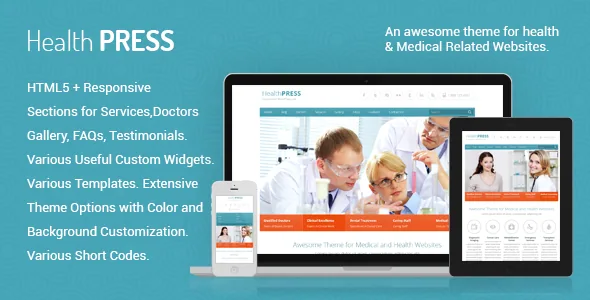
HealthPress gives each medical content type a small set of fixed templates. Doctors come in a two-column and a four-column version; services in one, three and four columns; galleries in two, three and four columns with sortable variants; FAQs in a full-width and a sidebar version. Three home page templates cover full-width content, sidebar content, and a variant that shows blog posts where doctors would otherwise sit.
That arrangement splits the work in a way that suits a practice. You enter a doctor once in the Doctors post type, filling meta boxes rather than designing a card, and the template decides how many appear per row. Moving from a four-column grid to a two-column one is a page setting, not a rebuild, because the entries stay where they are.
Without a builder, the theme's own templates are the design. Any variation beyond the column counts the vendor lists means working with the theme's templates and styles rather than dragging new sections into place.
Appointment requests and the contact page
The vendor's widget list includes an Appointment widget with AJAX submission and CAPTCHA support, a Quick Contact widget, footer information and footer location widgets, a recent-posts-with-thumbnails widget, and a newsletter subscription widget that the listing says also works with the MailChimp plugin. Contact Form 7 compatibility is listed separately, so a form with your own fields and routing is possible outside the bundled widgets.
The contact page template bundles a Google Map, an AJAX contact form and CAPTCHA, and the changelog records a Customizer setting for the Google Maps API key added in version 1.7.1. That suggests the map is wired through the theme rather than a separate plugin, though the listing does not describe how requests are stored or delivered. Confirm that with the vendor's documentation before promising patients a response channel.
CAPTCHA is presented as a switchable theme option, added in version 1.5. Whether the challenge is on for the appointment form, the contact form, or both is something the settings answer, not the feature list.
Clinic details live in the header and footer
Two smaller additions in version 1.7.2 do a lot of quiet work for a medical practice: a sticky menu option and an opening-hours display in the header. A patient checking whether the clinic is open before calling does not need to scroll. The same release added a random doctors option to the home templates, a blog section in the home templates, an option for the home slider's autoplay, and a footer that hides itself when no widget is assigned.
Gallery detail pages support a slider, so before-and-after images or a facility walkthrough can be sequenced rather than presented as a static grid. For sliders in general the vendor lists two types, with Slider Revolution named as the additional one. The changelog shows that plugin bundled and updated through many releases, from version 1.5.1 onward.
Where global styling went, and how far Gutenberg reaches
HealthPress is not a page-builder theme. The feature list describes extensive theme options with many colour controls and custom background support, and the changelog shows that panel being retired: version 1.7 added Customizer controls to replace theme options, and version 1.8.0 removed theme options in favour of Customizer settings.
So global styling runs through the Customizer, and colour and background changes apply across the site rather than page by page. For content, version 1.9.0 included Gutenberg support to cover basic blocks. That is the vendor's own scope wording, and it describes coverage of basic blocks rather than block-based page design. The theme's structure still comes from its templates and post types.
A child theme and layered PSD files appear in the marketplace file list alongside the PHP, CSS and JS files, and version 1.8.0 added a POT file and Spanish and French translation files. Full localisation support with .po and .mo files is claimed in the feature list, and WPML appears in the compatible-with attributes.
Declared compatibility and the SEO claim
The marketplace listing observed on 4 November 2026 declares WordPress 6.0.x through 7.0.x and names Firefox, Safari, Opera, Chrome and Edge as supported browsers. Those are listing declarations rather than results from running the theme on a particular stack. The changelog is a more specific guide to what the author tested: version 1.9.4 records testing up to PHP 8.3.x, and version 1.9.5 records RTL styling fixes and a WordPress version update.
The vendor also describes the theme as search-engine optimised, citing hand-coded markup, careful heading order, primary content placed above secondary content, and sidebar and footer widgets that create internal links. Those describe markup structure as the author sees it. They are not a ranking result, and titles, descriptions and structured data still come from an SEO plugin or your own setup.
One claim is easy to misread. The listing's mention of Slider Revolution describes a slider type the theme offers; it does not say which plugin licence terms come with a given copy of the theme, so check the documentation that ships with the version you use.
Questions & answers
Can I run a small practice with only a few doctors?
Yes. The two-column doctors template is the lower-density option and suits a short roster, while the four-column version packs in more names. Both render from the same Doctors post type, so switching the page template does not mean re-entering your entries.
Do the doctor cards need to be designed individually?
No. Doctors, services, galleries, FAQs and testimonials are custom post types with meta boxes according to the vendor's feature list, so you fill in fields and the chosen template renders them. Layout variation comes from the column counts the theme offers.
Does the theme include its own appointment form?
The vendor lists an Appointment widget with AJAX submission and CAPTCHA support, and the contact page template includes an AJAX form with CAPTCHA. Contact Form 7 compatibility is listed separately if you need different fields or routing.