Two menus, two editors, and a filter that had to scale
Most trade themes in this bracket list layout counts. Fortunio's changelog shows where the vendor keeps spending effort instead, and three entries say something concrete about how the theme behaves day to day.
Version 2.17.0 reworked the scroll-to-anchor animation. The active menu item is now detected 30% from the top of the window rather than the middle, and the animation respects anchor settings and no longer breaks in Chromium-based browsers. For a forestry or timber company with a long single-page service overview, the menu item that highlights as you scroll is a small detail until it points at the wrong section. Version 2.16.0 added keyboard focus looping in the mobile menu, so Tab from the last item returns to the first.
The same release gave the WooCommerce Product Filter a search field for lists of 15 or more items and scrollable attribute lists in the sidebar, and made attribute detection faster on large stores. If the catalogue runs to dozens of timber grades, finishes or dimensions, that is the part of the shop to judge first.
Rounding this out, version 2.17.0 added an option to choose how theme styles reach the Gutenberg editor, either through add_editor_style or enqueue_style, and fixed block-editor font and icon loading.
What inheritance and override actually buys you
The theme's own short description names a system of inheritance and override options that sets individual parameters for different sections of a site and for supported plugins, and the vendor feature list repeats it under the theme framework as "Setting Inheritance and Override System", alongside 750+ customizer options and a custom theme options panel.
Read that as a settings chain: one global decision, replaced only where a page, section or plugin needs something different. On a site that mixes a services page, a team page and a products page, the alternative is a separate configuration pass for each. How far the override reaches in practice is a question worth testing on your own page structure rather than assuming from a feature bullet.
The frame of the site runs through the same editor. The vendor lists header and footer layouts as customisable in Elementor, alongside boxed and fullwidth page layouts as layout options. Those are two container choices for content built in the builder, not templates you edit around.
Six homepages, and the imagery that does not come with them
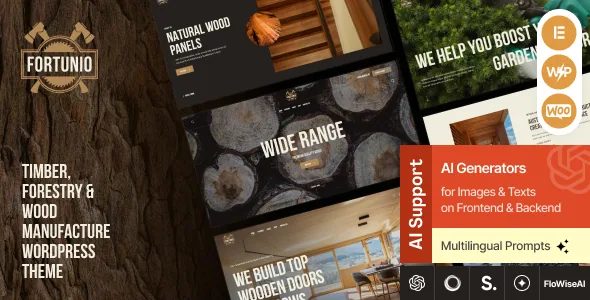
The vendor's list includes six premade homepages with accompanying menu styles, plus premade pages for services, team, products and shortcodes. Set against the audiences named in the description — timber companies, forestry firms, wood crafters and manufacturers, and land management businesses — that covers the usual shape of such a site: what you do, who runs it, what you sell.
Six variants do not mean six independent builds. Combine them with the override layer and you adjust the sections that differ instead of rebuilding colour, typography and spacing for each one. Treat the demo previews as layout guidance rather than as a photography source; nothing in the listing says the preview images are licensed for your site, so plan on commissioning or licensing forestry, workshop and product photographs.
Shared across the layouts are flexible colour and typography settings, the Fontello and Google Fonts icon and type options, and an interactive Ajax search in the header.
WooCommerce: declared versions against a changing shop layer
The compatible-with attribute names WooCommerce 6.x through 9.x, plus Elementor, Elementor Pro and WPML, and the vendor describes full WooCommerce store compatibility with a wood products store as an intended use. Adapters for a manufacturer selling boards, furniture or craft items next to its service pages, provided the catalogue matches the theme's product layouts.
The changelog shows that layer being maintained against plugin changes rather than frozen: search from a single product page now opens the shop page, custom product tab priority was adjusted to work alongside Elementor Pro tabs, and PHP warnings with the latest WooCommerce in custom term list columns were fixed. Version 2.16.0 made the Cart widget's selectors override plugin and theme styles and added a filter to disable selected TrxAddons WooCommerce components so a third-party plugin can register its own conflict-free.
None of this establishes how your catalogue size behaves on your host. Filtering, wishlists (TI WooCommerce Wishlist is in the vendor's plugin list) and WPML-multilingual shops all lean on plugins, so test with real product counts before committing to a shop structure.
Where the AI helper sits in the stack
AI Engine appears in the vendor's plugin compatibility list as a ChatGPT chatbot and content generator, and the theme's changelog tracks an AI Helper of its own that is used by shortcode generators and an admin-side assistant chat. Version 2.14.0 added voice input and speech-to-text so prompts can be dictated into shortcode fields. Version 2.17.0 moved assistants from the retired OpenAI Assistants API to the Responses API with vector stores, and added per-assistant model, vector store and instruction settings.
That makes it an addon with dependencies: API credentials, admin configuration, and behaviour that follows a third-party service. Nothing in the feature list suggests you must enable it to build a site.
The changelog also shows the attack surface such an addon opens. Version 2.17.0 records fixes for a potential SSRF through SVG images loaded by URL and through AI Helper uploads, stored XSS in several Elementor and Instagram widget contexts, and PHP object injection in a settings decode function. Those are patches for issues found, not proof either way about safety on your server — but they are a reason to keep the theme and its bundled addons updated rather than parked at install.
What the marketplace listing declares, observed 4 November 2026
The software version attribute spans WordPress 4.9.x through 7.0.x, which is a wide declared range, and browsers are listed as Firefox, Safari, Opera, Chrome and Edge. Files included are recorded as PHP, CSS and JS; Widget Ready is marked Yes and documentation Well Documented. Both are vendor declarations rather than a reviewed manual. Gutenberg Optimized is marked Yes.
Missing from the record is any measurable performance or security result. A vendor line describing a framework as optimised for best performance says nothing about speed on your content, your plugins or your host. The practical way to settle the theme's fit is to render a header and footer override on a real page and to run the product filter against your own catalogue size; colours, typography and boxed-versus-fullwidth are build-time settings you will change anyway.
Questions & answers
Does the inheritance and override system replace a child theme?
Not as described. The vendor presents it as a way to set individual parameters for different sections of a site and for supported plugins, which is a settings-layer approach. A child theme remains the normal place for code-level changes to templates and functions.
Can I write content in the block editor instead of Elementor?
The marketplace marks Gutenberg Optimized as Yes, and recent releases fixed block-editor font and icon loading and added a choice between add_editor_style and enqueue_style for theme styles. Content in blocks is supported. The demos, headers and footers are described as Elementor work, so block-built pages will not automatically match the demo layouts.
Is Slider Revolution bundled with the theme?
The vendor's feature list states that Slider Revolution and Swiper Slider are included, and Slider Revolution appears again in the plugin compatibility list. That is a vendor statement about the product; confirm what a specific package contains before building a layout that depends on the bundled plugin.