Results that carry player performance, not just a scoreline
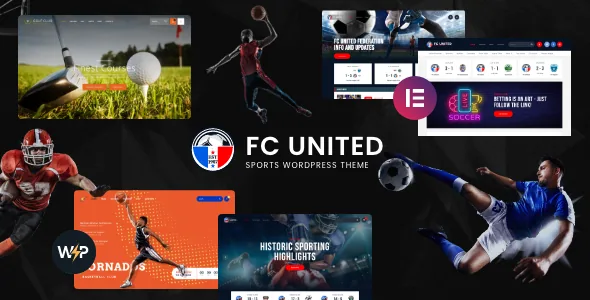
Most sports themes give you a match page. FC United's vendor describes fixtures and results recorded with player performance attached, which turns a result into a record that feeds the rest of the site. Player profiles show statistics, staff get their own profiles, and a club profile carries a roster. Publish a result properly and those connected pages have something to display.
The vendor keeps two of these structures explicit. League standings are described as auto-calculated rather than typed in. Separately, statistics and league-table columns are configurable, so a competition that counts different things per division can adjust what a table shows. There is also a choice between club-versus-club and player-versus-player modes, which changes what a result refers to — a team fixture or an individual contest. Pick that mode early, because it shapes how every later entry is recorded.
A CSV import path covers events, clubs, players and staff, and sport presets pre-set the counting rules for a given sport. For a club joining mid-season with a spreadsheet already in use, that is a way to seed the site rather than retype a squad.
Elementor builds the frame, including header and footer
The vendor says pages are made in Elementor and that header and footer layouts are customisable there too. That makes the chrome of the site editable in the same tool as the content, which matters when a sponsor strip or a fixtures bar needs to sit above every page.
Underneath, the theme metadata describes a system of inheritance and override for setting individual parameters per section of the site and per supported plugin. The idea is scoping: a global value that a section can override locally, rather than one site-wide setting you work around. The feature list counts 750+ Customizer options.
The changelog supports an Elementor-first reading. Version 2.2.0 declared compatibility with the Elementor V4 builder and support for V4 Atomic widgets, and added a demo built entirely from those widgets. If you build new pages with current Elementor tooling, the theme's recent work is aimed there.
The plugin list in the description is older than the theme
The long marketplace description still names Slider Revolution, Essential Grid, Contact Form 7, The Events Calendar, Mailchimp for WordPress and Smash Balloon's Instagram Feed among the plugins you will be working with. The changelog for version 2.0.0 records their removal, along with ThemeREX Socials, and the addition of MetForm.
So a slider-heavy homepage, a general event calendar or a newsletter signup are now your plugin decisions and your maintenance, not something handed over with the theme. The listing's compatibility field still lists Events Calendar alongside Elementor, WooCommerce 5.x through 10.x and WPML, which is one more reason to treat any single record as partial. The vendor's release notes for the version you intend to run are the reliable source.
What survived the rebuild is the point. SportsPress-based sports tooling remains the centre of the vendor's feature list.
Shop pages that share the club's layout
WooCommerce support is described as full, with the shop framed around sportswear, kit, equipment, jerseys and shirts. The practical value for a club is that the store sits inside the same design as the fixtures and news pages rather than beside them, which matters when merchandise is sold around a season rather than as a separate business.
WPML appears in the compatibility field too. If club pages or product copy need to exist in more than one language, that is the entry worth checking against the current release. These are vendor declarations observed in November 2026, not the outcome of running the theme against your WooCommerce version, payment plugins or shipping setup.
The blog controls are more specific than usual
The vendor lists multiple blog styles, flexible layout options, 20+ post animations, and a blog feed that can be limited by post type or category. It also names post views, likes and sharing buttons, and a related posts section.
Limiting a feed by category is the useful one for a club. Match reports, first-team news and junior results can live in separate categories, and a homepage block can pull only the feed you want instead of whatever was published last. Around this sit the smaller working parts: galleries and shortcodes, custom widget sets and custom post types, Fontello and image icons, Google Fonts, boxed and full-width layouts, and an Ajax search.
Photography, Gutenberg Optimized and the files
The vendor states that images used in the live preview are not included and remain the property of their owners. On a sports site that is the largest piece of work on the list: action photography, squad line-ups and ground shots need licensing or a photographer, and player photographs — especially for youth teams — usually need consent before publication.
The files list names PHP, CSS and JavaScript. Gutenberg Optimized is recorded as No, which describes whether block-editor layouts get styling priority; it does not mean the block editor stops working. Read it as confirmation that the editing surface here is Elementor plus the theme's settings layer.
Questions & answers
Does FC United still include Slider Revolution or The Events Calendar?
Not according to the vendor's changelog. Version 2.0.0 records the removal of Slider Revolution, The Events Calendar, Contact Form 7, Essential Grid, Mailchimp for WordPress, Smash Balloon's Instagram Feed and ThemeREX Socials, with MetForm added. The longer description still names several of those plugins, so check the release notes for the version you plan to run.
How does a league table get its numbers?
The vendor describes standings as auto-calculated, with configurable statistics and league-table columns and a choice between club-versus-club and player-versus-player modes. The configuration lives in SportsPress, which the theme is built around, instead of in hand-written HTML tables.
Can you start from an existing season spreadsheet?
The vendor lists CSV import for events, clubs, players and staff, plus sport presets. The description does not state the exact column format or how partial imports are handled, so test with a small file before loading a full season.
Does Gutenberg Optimized set to No mean the block editor is unusable?
No. That attribute describes whether block-editor layouts are a styling priority. FC United builds pages, headers and footers in Elementor, so plan your editing workflow around Elementor and the theme's settings layer.