Two vintages of theme in one package
Most themes tell you what they are through a builder name. Energy tells you through its changelog, and the interesting part is that the stack has two ages.
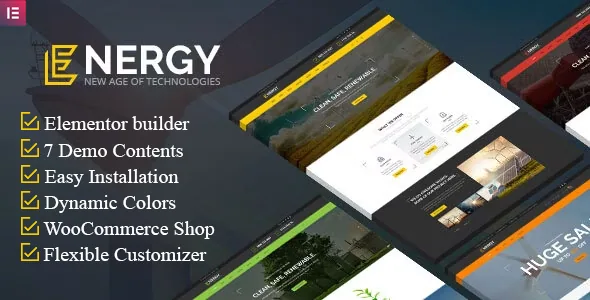
Version 1.5.6, dated February 4, 2024, records that the theme engine "is compatible with Elementor page builder." That is a retrofit, not an origin story: the theme first appeared in January 2017 and spent its early years as a shortcode-and-Unyson build. Elementor is now listed among the compatible plugins and the vendor describes editing as live drag-and-drop without programming.
Read that as the editing layer having been replaced while the theme's own content machinery stayed put. The releases after the conversion point the same way: 1.5.7 in June 2025 and 1.5.8 in May 2026 are both logged as updates for the Elementor and demo-content installation plugins, with 1.5.8 also noting security updates and minor plugin bugs. Those are vendor claims from the marketplace description; nothing here is a hands-on test of the build.
The Unyson-era parts you will still meet
The 2022 changelog is the clearest picture of the older half. Version 1.5.3, dated May 20, 2022, fixes a fatal error that occurred when the Unyson services extension was disabled, returns the classic widgets screen, and adds a background overlay to the intro Revolution Slider.
Each of those entries describes something still present at that point: a Services content type running on a theme extension rather than Elementor widgets, a widgets screen that behaves the classic way rather than through block-based widgets, and slider handling inherited from before the builder conversion.
None of this has to be a problem. If you plan to build pages in Elementor and leave the theme panels alone, the legacy pieces sit quietly. If you plan to sell services from the theme's own Services items, you are working with the part of the theme that predates the builder, and it is worth knowing which layer owns which page before you design anything.
A services list that takes your own icons
The vendor pitches Energy at solar and wind farms, hydro stations, biogas plants, geothermal facilities, biofuel producers and waste-recycling operations, and the Services content type is the piece with the most documented detail.
Version 1.5.2, dated June 3, 2021, made it possible to upload custom icons for Services, and the 2022 release updated the services plugin to display that uploaded icon. For a company selling panel installation, turbine maintenance or plant construction, that turns the services list into an icon-led grid carrying your own symbols rather than a fixed icon set.
Alongside Services, the vendor describes blog and gallery sections for project photos and updates, and an events section "to help you keep in touch with your customers." Keep that last claim narrow: an events section is described as part of the content mix, not as a booking or ticketing system. The number of demo pages and how these components behave on a current WordPress install are not established by the marketplace text.
Shop support, and where the claim stops
Energy is described as WooCommerce compatible, with the theme able to carry a shop for solar panels, wind turbines and other alternative-energy equipment. The changelog gives the claim a date: version 1.5.0, July 27, 2020, added a demo specifically for the WooCommerce shop.
The vendor also credits a WooCommerce update with product quick view, add to wishlist, advanced product card management, and improved checkout and cart page layouts — storefront conveniences that otherwise come from extra plugins.
The declared compatibility attributes, observed on 4 November 2026, list WooCommerce 6.x through 9.x alongside Contact Form 7, Elementor and Elementor Pro. That is a vendor-declared range, not a tested matrix, and the last WooCommerce-specific changelog entry in the supplied material is the 2022 bump of template overrides to remove warnings. On a newer major WooCommerce version, check cart and product templates on a staging copy before loading a real catalogue. The theme supplies storefront presentation; your products, shipping, tax and payments remain your configuration.
Layered PSDs, and the resolution caveat
The ThemeForest file list for Energy names Layered PSD and PSD entries next to the PHP, CSS and JS files. That is unusual: most theme packages ship code and demo content, leaving design assets to be rebuilt in a browser.
Editable source is the difference between matching a banner or service graphic to the site's look and recreating it from scratch. If a designer on your team reworks campaign layouts, the PSDs shorten that loop.
The same attribute list marks High Resolution as No. Treat that as a prompt to open the specific assets you intend to reuse and check their pixel dimensions, especially for print or large-format work, rather than assuming the source files are print-ready.
Block editor label, without a verdict
Gutenberg Optimized is marked No, which states only that the vendor does not describe the theme as tuned for the block editor. It does not mean the block editor is switched off.
In practice, your layout work happens in Elementor and the theme's own settings, and posts written in blocks will inherit the theme's typography and container widths. Declared WordPress support runs from 6.1.x to 6.9.x, and browsers listed are Chrome, Firefox, Safari, Edge and Opera. If your content already lives in blocks and your pages in a builder, expect two editing surfaces rather than one.
Where the mixed stack lands
Energy makes most sense for a renewables or energy-efficiency business that wants a sector-shaped site — icon-led services, project galleries, news, an events section and a modest equipment shop — and is content to build pages in Elementor. The shop demo and the layered PSDs are the two pieces you would otherwise source separately.
The friction is the split ownership of the site: Elementor for pages, a theme extension for services, classic widgets for sidebars, and slider assets from before the conversion. Decide which layer owns each region before you migrate content, and settle it on a staging install, because that decision shapes both your page templates and what you maintain later.
Questions & answers
Does Energy need the Elementor plugin installed to work?
The vendor describes the theme engine as Elementor-compatible since version 1.5.6 and lists Elementor and Elementor Pro among compatible plugins. The supplied material does not say whether the theme renders without the plugin installed, so test that on a staging copy if it matters to your setup.
Are the Services items edited inside Elementor?
The evidence points to the theme's own services extension handling them, including the per-service custom icon upload added in version 1.5.2 and a 2022 update for displaying that icon. Elementor compatibility arrived in 2024, so the two are separate systems; how Services items surface inside Elementor layouts is not described.
What does the events section do?
The vendor lists an events section alongside the blog and gallery as a way to keep in touch with customers. The description does not present it as a booking, registration or ticketing system, so plan on it being a content and display feature.