One theme, five restaurant identities
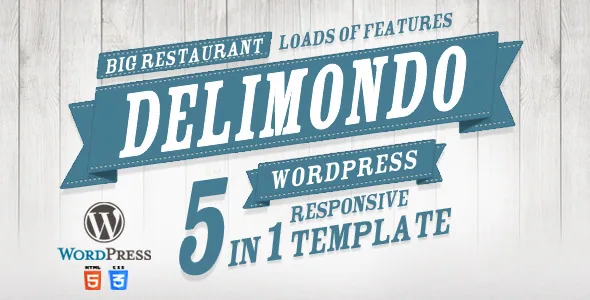
Delimondo's defining feature is not a builder. It is that the package contains five named restaurant designs, each with its own photographic mood and typographic tone. The vendor's description assigns an intended venue to each: Seafresh for seafood or an old country-house restaurant, Cupcakeheaven for bakeries and pastry businesses, Amici & Pizza for a pizzeria or pasta place, Black Angus for grill, barbecue and burger restaurants, and Le Canard for modern fine dining and haute cuisine.
The vendor adds that none of the five is a restriction, and suggests swapping imagery through smart objects to push a design in another direction. So they work as complete starting points rather than enforced categories.
The marketplace records the underlying WordPress theme name as Seafresh, described as the responsive Seafresh template, which points to the seafood concept as the installable theme from which the other looks derive. The description does not explain the switching mechanism, so the documentation is the place to confirm how one install serves several designs.
Dishes stored as entries, not retyped into pages
The feature list includes custom product types with the claim that you can create menus quickly. That is the most restaurant-specific tool in the package: a dish is an entry with its own fields rather than a line of text inside a page, so a price change happens once instead of in every layout that names the dish.
Two menu-card designs are listed, and they answer different visitor situations. The two-thirds, one-page card keeps a menu as a continuous scroll, which is what someone deciding what to eat usually wants. The full-width book style spreads the same content across a wider, printed-card-like layout.
The vendor applies the same width split to homepages, listing a two-thirds and a full-width version. Since the pattern repeats across menus, homepages and sliders, it is worth settling before the build rather than per page.
The restaurant modules the vendor lists
Beyond the menu, the description names sections built for food: a featured dishes slider, a daily recommendations section the vendor describes as highly flexible, a four-column gallery slider, and a team slider that carries the same flexible billing. Daily recommendations are the piece that suits a kitchen with changing specials, since the section is designed to be refreshed rather than set once.
Two slider systems sit alongside each other. Revolution Slider is bundled, and two Nivo-based options are listed in two-thirds and full-width variants that adapt to screen size. Splitting those jobs lets a hero stay fixed while in-page image rows change independently.
For enquiries, the vendor lists a form-validated contact form and a jQuery-driven "Book a Table" form in desktop and mobile versions. Nothing in the description names a reservation service behind the booking form, so it reads as a visitor request form; decide separately where submissions should land before telling a client it manages tables.
Shortcodes and widgets are the editing model
No page builder appears in the Delimondo description. Layout comes from 42 prebuilt shortcodes with a shortcode generator, alongside nine prebuilt widgets and unlimited sidebars. You place elements through the generator and arrange them in the content area.
That works, but it keeps a page's structure in shortcode markup rather than in a visual canvas. If the site will be handed to a restaurateur who expects to rearrange sections by dragging, plan for that conversation early. Widget-ready is marked Yes in the marketplace attributes and documentation is marked well documented.
Typography runs through Google Fonts, with 600+ listed, and the vendor states that only free Google fonts are used apart from the Seafresh logo.
Layer comps and smart objects in the PSD bundle
Included files are listed as layered PSD, PHP, CSS and JS, and the vendor gives Photoshop its own section of the description: all PSD documents are included, organised with layer comps and colour-coded, logically named groups, and editable through smart objects, with a how-to file covering the workflow.
For a restaurant launch this earns its place. Menu cards, dish photography and promotion graphics often get produced as images before anything reaches WordPress, and smart objects let you drop new photography into a finished layout instead of rebuilding it.
That layered-source convenience applies to the design files. The WordPress side still runs on the shortcode and widget system described above.
The declared environment, observed 4 November 2026
The marketplace software version attribute names WordPress 4.9.x only. Compatible-with lists WPML, and the description states the theme is translation ready with .po/.mo files included. Compatible browsers are recorded as IE9 through IE11, Firefox, Safari, Opera, Chrome and Edge.
The listing also records the vendor's last update as 16 April 2018 and marks Gutenberg Optimized as No. Read the second point precisely: it describes the editing route the vendor supports, not the removal of the block editor. Ordinary posts can still be written in blocks; a page assembled in blocks should not be expected to reproduce the demos, which were built with shortcodes.
A narrow declared version range and a 2018 update date are the material uncertainty. The supplied evidence shows no testing on a current WordPress release, a recent PHP version or a modern plugin stack, and WPML compatibility is a vendor claim rather than a verified pairing. Check the theme on the environment you intend to deploy before committing a client site.
The vendor also states that support runs through its own support forum, with pre-sale questions answered in the marketplace comments. That describes process, not response times or how long support will continue.
Questions & answers
How do I get from the Seafresh install to Cupcakeheaven, Amici & Pizza, Black Angus or Le Canard?
The marketplace records Seafresh as the theme name, and the vendor presents the other four as further templates in the package. The supplied description does not explain the mechanism, so confirm it in the bundled documentation before planning a build around a specific look rather than assuming a single switch.
Can I write posts in the block editor?
Gutenberg Optimized is marked No, which describes the editing route the vendor supports rather than any switch that disables blocks. Standard posts can be written in blocks; the demo page layouts themselves come from shortcodes, so a block-built page will not match them.
Does the Book a Table form connect to a reservation system?
The vendor lists a jQuery-driven "Book a Table" form in desktop and mobile versions and names no booking service behind it. Treat it as the form visitors fill in and decide separately how those submissions reach the restaurant.