Two vendor statements pull apart on demo images
WolfThemes lists one-click demo content import and says all images are included for quick setup. Further down the same description, an artwork credit note names the designers behind the preview pieces and then states that those credited works are presentational only and replaced by placeholder images in the theme package.
Read together, the useful expectation is a complete demo structure — pages, layouts, menus — with placeholder graphics where the preview shows licensed album art and photography. Release covers and press photos are yours to supply. That is a common arrangement for a demo import, but the contradiction inside one listing makes it easy to misread, so plan the artwork as part of the build rather than as something that arrives with the import.
The declared file set backs this up in a small way: PHP, CSS and JS files plus PSD. The layered source files are there for adapting graphic elements to your own branding, not for lifting the credited artwork.
The playlist manager is listed apart from the players
The feature list separates "Audio Players with Spotify Integration" from a "Playlist manager", and that wording is worth taking literally. A player is something you place on a page; a playlist manager implies the running order is stored once and reused.
If that is how it works, it suits a site that changes with each release: you curate a listening order and the pages that should carry music inherit it, instead of rebuilding embeds by hand each time. The vendor does not say how far the Spotify side extends — whether it embeds Spotify content, reads playlist data, or both. Nor does the description connect the players to the discography or the shop, so treat listening, releases and commerce as elements that share a site rather than one wired pipeline. If Spotify is central to your audience, that is the detail to verify yourself before committing.
Discography as an element, not twelve hand-built pages
Discography appears as a named theme element, described as a way to showcase albums and tracks. The practical difference shows up as the catalogue grows: a new release becomes an entry in the same presentation rather than a page you duplicate, reformat and relink. A dozen back-catalogue releases then stay consistent without a layout revision each time.
How much structure that entry gives you is not documented. Nothing in the marketplace description mentions release date, track listing or a link out to streaming services, so look at demo pages to see which fields a release actually carries. "Showcase beautifully" is a presentation claim, not a specification.
Gigs, video and merch: three more named elements
Event management is listed for promoting gigs, tours and shows. The description stops at the purpose — no date archive, venue fields or ticketing are described — so a show listing is one of the first things to inspect in the demo if touring is a regular task.
A video gallery covers music videos and visual content, and a WooCommerce shop covers selling music and merchandise. The listing's compatibility attributes, observed on 3 November 2026, declare WooCommerce 10.x.x and WPBakery Page Builder alongside Contact Form 7, which places the shop inside a recent WooCommerce branch. That declaration does not say which product types or templates the vendor exercised, so a store mixing physical merch with digital releases is worth testing on staging.
Slider Revolution also appears in the vendor's feature list, described as a $109 value included. That is a slider tool for hero sections and layered visual sequences — separate from the audio and playlist elements, and a different part of the homepage plan. The terms of the bundled licence are not spelled out in the description.
Where pages are edited, and what the Gutenberg mark means
Customisation runs on a WPBakery Page Builder canvas, with the vendor promising drag-and-drop work without coding, and WPBakery templates listed for reuse. For a homepage that gets rearranged between tours, that is the concrete workflow: rows and modules move, and previously built sections come back into play.
The listing also records Gutenberg Optimized as No. In practice that says the theme was not built or tuned around the block editor, so block patterns and block styles matching the design are unlikely. WordPress still offers the block editor for blog posts and news items; what you should not expect is the page layouts built in it. If your team already works in blocks, the WPBakery arrangement will feel like a second system. If page building happens visually in WPBakery and the blog stays ordinary posts, the split is the one the theme was designed around.
Version declarations are claims, not test results
The listing declares WordPress 7.0.x software compatibility, a responsive layout, widget-ready sidebars, high-resolution assets and support across Chrome, Firefox, Safari, Opera and Edge, with a vendor update dated 21 October 2026 and a marketplace version of 3.8.97 at the time of observation.
Those are declarations attached to the listing. Nothing here comes from installing or exercising the theme, and listed integrations are not proof that every demo depends on them — a WPBakery entry, for instance, describes the editing layer rather than a required plugin for every page.
What the record tells you is where to check rather than what will happen. If your stack has moved past the declared version bands, that combination is untested rather than confirmed, and the theme's own changelog and knowledge base links are the place to look for how it has kept pace.
Sizing the theme against a real site
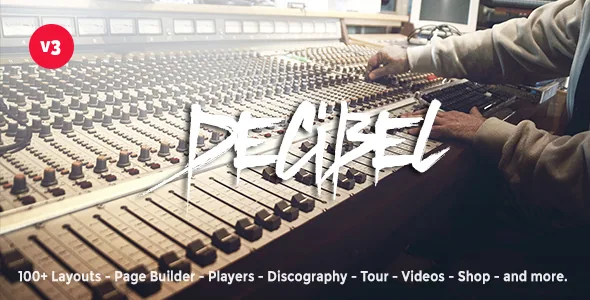
Decibel makes sense when a site has recurring music work: releases to publish, playlists to keep current, dates to announce, videos to show, and music or merch to sell. The element list matches that rhythm, and WPBakery gives you a visual way to rearrange the homepage around whatever is newest.
A site that mostly publishes writing with an occasional album carries more machinery than it needs — the discography, shop and event elements exist whether or not your calendar fills up. The decision is less about genre than about whether those recurring updates are the site's main job.
Questions & answers
Do the audio players need WooCommerce to work?
No dependency is described. The audio players, Spotify integration and playlist manager sit in the feature list separately from the WooCommerce shop, which is presented as a way to sell music and merchandise. The listening elements are described as standing on their own.
Can I publish the album artwork from the Decibel preview?
The vendor's credit note says the credited artworks are used for presentation only and are replaced by placeholder images in the theme package, and that permission must be sought from the designers for live use. Supply your own release covers and press photography.
Does Gutenberg Optimized set to No block the block editor?
It indicates the theme was not built or tuned around the block editor, so design-matching block patterns and styles are unlikely. Post writing in the block editor remains standard WordPress; the theme's page layouts are assembled in WPBakery.