A deal is its own content type here
CouponHut's vendor describes the offers as living in a separate Deals post type, kept apart from WooCommerce's Product post type, with Deal Company and Deal Category as their own taxonomies. For a coupon site that is the decision that shapes everything else: a merchant is a structured record you filter and browse by, not a word typed into a body field. WooCommerce still supplies registration, payment and cart, so the shop machinery exists beside the deal layer rather than underneath it.
The vendor also states the trade-off directly: WooCommerce plugins that require the Products post type will not work with CouponHut. A product feed manager, a variation tool or a product table has nothing to attach to. If the plan needs those, this is not the theme for it.
Expiry is designed into the layout, not bolted on
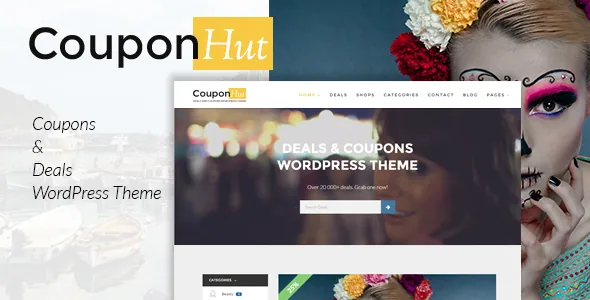
The description treats offer expiry as a presentation element. The remaining time can appear as a thumbnail on the homepage, and the full offer page is described as carrying icons, countdown clocks and company details. Two of the ten listed page templates serve this directly — Expiring Deals and Popular Deals — alongside Browse Deals, Browse Companies and Browse Categories.
The widget set follows the same structure. Deal Companies, Deal Categories, Deal Filter and Deal Search each handle one browsing job, with a Daily Deal widget for a featured offer, plus Mailchimp, Image, Social, Recent Posts and Twitter widgets, ten in all. The theme is marked widget-ready.
Filters use the taxonomies the theme already has
The vendor lists advanced customer filters: a slider for what expires soonest, and dropdowns to narrow by brand, category or company. Because company and category are taxonomies on the Deal post type, those dropdowns have structured data to read.
The description does not say whether the expiry slider and a company dropdown can be combined in one query, so treat the exact filter behaviour as something to check on the demo. The Expiring Deals and Popular Deals templates imply two separate sort intents, which is a different matter from combined filtering.
Star ratings ship with the theme
A star rating system is described as integrated into the theme's core, offered as an alternative to installing another plugin for the purpose. Ratings are a natural fit for offers, where buyers often want a signal before they click through.
The vendor does not say whether ratings are open to every visitor or tied to the membership registration that also appears in the feature list. If user-submitted ratings are central to your plan, confirm that before committing. Rich snippets are listed too, which matters for an offers site that wants its deal markup picked up by search engines.
Unyson handles pages, shortcodes handle the rest
Pages are assembled in the Unyson page builder, and shortcodes extend the same elements into posts, pages and widget areas. The marketplace attribute for Gutenberg Optimized is marked No, which describes the editing path the vendor supports; it does not mean posts cannot be written in the block editor, only that the theme's page elements live in Unyson rather than in blocks.
Smaller controls sit around that. A custom CSS field gives you a place for overrides without editing theme files, and the included files are recorded as PHP, CSS and JS. The vendor lists 700+ Google Fonts and 2000+ Iconsmind premium icons for styling range, WPML support with .po and .mo files for translation, and threaded comments. The Deal post type and both taxonomies can be renamed, so the site can call a deal an offer or a company a merchant without touching code.
What the demo import leaves you to supply
The one-click demo install is described as including no images. You get populated structure and supply the merchant logos and offer photography yourself — a realistic starting point for a coupon site, but not a finished-looking one on day one.
The listing, as observed on 4 November 2026, declares compatibility with WooCommerce 5.x through 9.x and WordPress 6.5.x through 6.9.x, with browsers listed as Chrome, Firefox, Safari, Opera, Edge and IE11. Those are vendor declarations, not results from running the theme on your host, PHP build or plugin set. Documentation is described as well documented, and support is scoped to setup, feature problems and bug fixes, excluding third-party plugins and modifications.
CouponHut fits when deals are the content and you want expiry, merchant and category stored as first-class data. If your storefront depends on extensions built for WooCommerce products, the separate Deal post type is where the plan breaks.
Questions & answers
Can I use WooCommerce product plugins with CouponHut?
The vendor states that WooCommerce plugins requiring the Products post type will not work, because offers are stored in the theme's own Deals post type. WooCommerce is still used for registration, payment and cart. Test any extension you depend on against that restriction.
Does the demo import include images?
No. The vendor describes the one-click demo install as including no images, so merchant logos and offer imagery are yours to supply.
Can I rename the Deal post type and its taxonomies?
Yes. Renaming the Deal post type and the Deal Company and Deal Category taxonomies is listed among the theme's features, so the site vocabulary can match how you talk about offers.