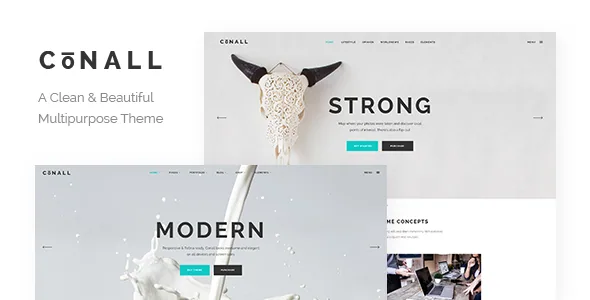
Five header types, and a separate logo for each state
Most themes give you a logo field and a choice between a light and dark bar. Conall's vendor feature list goes further: five header types, multiple header behaviours, and independent logo settings for the mobile header, for light and dark header versions, and for the sticky header. There are also separate style settings for the mobile header and header top and bottom widget areas.
That matters if your brand mark changes shape between a wide desktop bar and a narrow phone screen. A crowded horizontal logo can collapse into a compact symbol for mobile without editing CSS, and a sticky bar that sits over content can load a different mark from the one in a light hero header. The widget areas above and below the header are the other half of the idea, giving you a strip for a phone number, a language switcher or a promotion that isn't part of the menu.
A fullscreen menu and a customisable mega menu come with it, so a site with many sections can route visitors through a full-screen overlay on small screens and a columned dropdown on desktop. Anchor functionality for one-page sites is listed alongside these, which means the same header can drive a long scrolling landing page.
The Edge Slider does the presentation work
The slider bundled with the theme is Edge's own rather than a third-party one, and the vendor lists image and video support, zoom animations on slider images, a parallax effect on slides, and various slide animation types. Parallax also appears outside the slider: a Parallax Sections shortcode and parallax images within sections let a mid-page band move at a different rate from the rest of the content.
The practical question is where you use it. A hero slider with a slow zoom on a still photograph gives a polished, editorial feel for an agency or studio homepage. Parallax on a full-width section does the same job for a single image without needing a slider at all.
Both effects assume a large, quiet image. If the section behind a parallax band carries text, prices or a form, the movement competes with reading. Reserve those treatments for short calls to action and let the rest of the page sit still.
Portfolio and blog are two separate paths
Conall doesn't treat content as one undifferentiated stream. Portfolio lists come in masonry, Pinterest-style and gallery layouts, with multiple hover treatments on the grid items, plus a portfolio slider and an image and video lightbox for single items. Blog listings come in masonry, split-column and standard layouts, and posts carry custom formats for audio, video, standard, gallery, link and quote.
For a studio or agency, that split is the useful part. Case studies belong in a portfolio grid where hover reveals a title and the lightbox enlarges an image or plays a video. Written commentary belongs in the blog, where the split-column layout gives a long article a narrower measure and a masonry layout makes a mixed feed of formats read as a magazine.
Post formats do real work here. A video post and a quote post get their own treatments in listings, so a blog mixing written pieces with clips and short links doesn't look like a template filled with mismatched entries.
Editing happens in WPBakery, with type set once
Pages are assembled in WPBakery Page Builder, which the vendor includes in the package, and Slider Revolution is bundled as well. A large collection of custom shortcodes covers the pieces the vendor wants you to place without building them: gallery blocks, a team carousel, pricing tables, testimonials, infographic and animation holders, a product list and a call-to-action slider. One-click demo import seeds the layout so you start from a populated page.
Typography sits in the theme options rather than per block: highly customisable type settings, a separate set for responsive breakpoints, and a library of 600+ Google Fonts. A 2023 release added a disable option for Google Fonts, which is the switch to use when local hosting or EU data-transfer rules mean you can't call Google's font servers.
Where the build is headed is worth stating plainly. Editing happens in a shortcode-driven builder, not the block editor, so the people maintaining the site need to be comfortable there.
The Twitter and Instagram feed plugins are gone from the bundle
The vendor feature list still names a Twitter feed widget and an Instagram feed widget, and that list is out of date on both counts. Version 2.4, in August 2023, removed the Twitter plugin because of Twitter API changes. Version 2.5, in September 2025, removed the Edge Instagram Feed plugin because of Instagram API changes.
These are removals, not deprecations: the changelog records the plugins leaving the package, so a fresh install no longer contains the feed code those widgets depended on. The practical consequence is narrow but concrete. Any plan that assumed a bundled feed strip, whether an Instagram grid in the footer or a Twitter column in the side area, needs a different source for that content, and the widget names in the older feature list shouldn't be read as current inclusions.
Both removals follow the platforms themselves. Instagram and Twitter API changes have broken third-party feeds across the WordPress ecosystem, and a vendor that deletes a widget it can no longer support is being more accurate than one that leaves it on the list. The social icons widget, which is just links and doesn't touch an API, remains a separate item in the feature list and is unaffected.
What the 2025 release added, and what compatibility is claimed
Version 2.5, dated 23 September 2025, added a WPML config file and WooCommerce 10.x compatibility, improved Google Maps API and PHP 8.3 compatibility, and updated the bundled WPBakery and Revolution Slider plugins. In the same release, the WooCommerce dropdown cart was stopped from loading on the cart page itself.
The WPML config file is the change worth noting for non-English sites. The theme was already translation-ready with po/mo files; a config file is what makes string translation and multilingual setup a documented path rather than an experiment.
Marketplace attributes observed on 4 November 2026 list WordPress 6.5.x through 7.0.x, WooCommerce 9.x and 10.x, WPBakery and WPML as compatible, with PHP, CSS and JS files in the download and a child theme included. Those are vendor claims, not results of testing your install. Two caveats belong with them: Conall was first released in 2016, so it has carried its architecture through a decade of WordPress changes, and the demo photographs are presentational only; the vendor states you must license any stock image you want to use yourself.
Who this build suits
Conall's header system is the part you would struggle to reproduce quickly elsewhere: per-state logos, header widget areas above and below the menu, mega menu and fullscreen menu in one theme. Combined with the Edge Slider, parallax sections and three portfolio layouts, it covers a multisection site where presentation is the sales pitch — an agency, a design studio, a lifestyle publication or a fashion shop.
The commitment is the editing model and the ownership of the stack. You or your team work in WPBakery, and you keep WPBakery, Slider Revolution, the Edge Core plugin and WooCommerce current as they are released. If those terms fit how you already build, the header and portfolio layers give you plenty to work with before you touch a line of custom code.
Questions & answers
Can I set a different logo for the sticky header and the mobile header?
Yes, per the vendor feature list: separate logo fields are listed for the mobile header, for light and dark header versions, and for the sticky header type, with separate style settings for the mobile header as well. These are theme options rather than per-page overrides, so the change applies site-wide.
Does Conall still include an Instagram feed widget?
The feature list names one, but version 2.5 removed the Edge Instagram Feed plugin because of Instagram API changes, following the removal of the Twitter plugin in version 2.4. Plan on adding social feeds with a separate plugin instead of relying on what ships with the theme.
Is the theme translation-ready, and does it work with WPML?
The vendor lists translation readiness through po/mo files, and version 2.5 added a WPML config file. WPML also appears among the compatible plugins in the marketplace attributes observed on 4 November 2026. Those are vendor claims; confirm behaviour on a staging copy with your language setup.
Can I use the images from the demo site?
No. The vendor states that the images in the demos are used for presentation only and are not licensed for your site; you would need to license equivalent stock images yourself. Replace demo media during your own content pass.