Ten homepages, and a second set of ten
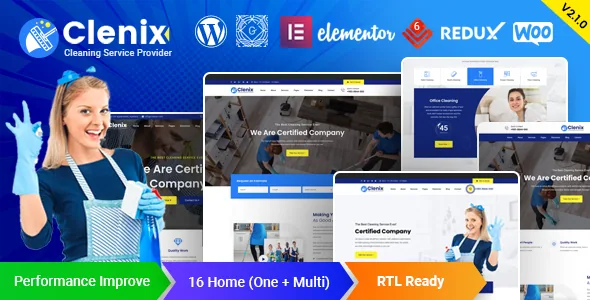
Clenix is sold to cleaning companies, and what the vendor puts first is volume: ten multipage homepages and ten one-page homepages. That parallel track is unusual. Most themes treat the one-page version as a single extra template; here the vendor counts the two sets separately, and the changelog agrees, with an early entry adding the one-page layout and later entries adding homepages in pairs.
For a cleaning business the two formats answer different jobs. A multipage layout is what you want when services, team and portfolio each need their own URL and their own search presence. A one-page layout compresses the same pitch into a single scroll, which suits a small operator whose entire message is the offer, the coverage area and a phone number.
Having twenty give you a wide choice before you start. It also means the choice is real work: the vendor's description does not say how much the ten layouts differ from each other structurally, so the live preview is where you judge whether you are picking ten designs or ten arrangements of the same design.
Services, teams and portfolios come in named multiples
The inner pages are counted precisely in the feature list rather than lumped together: seven portfolio layouts (three grid, two isotope, two masonry), eight team layouts (four grid, four slider), four service layouts (two grid, one slider, one tab), and two about pages.
Those numbers describe different browsing habits, not decoration. Grid portfolio layouts keep a set of completed jobs comparable at a glance, which suits an office-cleaning company showing rooms, floors and commercial sites. Isotope and masonry variants let tiles of unequal height settle together, useful when photos come from different cameras and framing. Slider treatments push one item at a time into view, better for a handful of showcase jobs than a long archive.
The same distinction applies to the team pages. Grid layouts put the whole crew on screen at once, which reads as scale; slider layouts pace them. For services, the tab layout is the one worth noting, because it lets a visitor switch between cleaning categories without leaving the page.
The changelog adds context: service, portfolio and team archive pages were added in a 2020 update. Archive templates mean those listings exist as pages in their own right, not only as blocks on a homepage.
Headers and the structural decisions that come early
The vendor lists eight header styles and says they can produce more than twelve header variations. Read that as structural variety combined with settings: the styles define where the logo, menu and contact details sit, and the variations follow from topbar choices and similar switches.
This is one of the decisions you cannot quietly reverse later. A header with a tall contact strip eats vertical space on every page; a slim sticky-style bar keeps the menu reachable but carries less information. Once the service and team pages are built around one header rhythm, switching means re-checking each layout.
Two changelog entries show where this area has needed repair rather than redesign: a header background fix, and mobile navigation fixes for a closing menu and a parent item that could not be clicked. Those are ordinary maintenance notes, but they point at the part of a cleaning site most of your visitors will actually use, since enquiries arrive from phones.
Two editing layers, and the plugins that sit inside them
The vendor describes the theme as working with Gutenberg and Elementor, and the marketplace attributes mark it as Gutenberg optimized and list Elementor among compatible tools. Both statements describe ways to edit; neither says the demo layouts are block-built. If you plan to hand pages to a client who edits in the block editor, confirm on a staged copy which pages are actually composed of blocks.
Bundled and supported plugins carry more of the practical weight. LayerSlider is named in the description as a premium slider included with the theme, and the changelog traces it from version 6 through 7.x releases, so the slider has been kept current well past the version the description mentions. A WooCommerce shop page is described as ready to personalise, which lets a cleaning company sell products such as supplies or equipment beside its services, and a ShopBuilder plugin was added in 2023. A booking plugin from the same developer was added in 2026 for online scheduling.
Treat each of those as a vendor claim. Whether the booking flow fits your actual cleaning schedule is a question for the demo and the documentation, not the feature list.
What you can change after launch without touching layouts
Colour is described as unlimited combinations, and the admin side is built on the Redux panel with WordPress Customizer options alongside it. In practice the split matters: the customizer is where a business owner adjusts site identity and the small settings that change with the season, while layout edits stay in the page builder.
Translation is handled through WPML support with a pot file included, and an RTL version was added in an early release. If a cleaning company operates in a bilingual city, the pot file means the theme's own strings can be translated even without a multilingual plugin.
A child theme is included in the package, which is the safe place for any CSS of your own. The marketplace file list names PHP, CSS and JS files, so what you receive is code, not design source files.
Demo import, images and the compatibility claim
The one-click demo importer is described as covering four home pages, so it does not reproduce all twenty layout variants. Expect to build the rest by composing pages from the included templates and sections.
Images are the larger exclusion. The vendor states plainly that premium images are not included and appear for demo purposes only, with the typefaces named as Poppins and Roboto. For a cleaning site, photography of actual teams, vehicles and finished rooms is the content that convinces a customer, so budget for a shoot or licensed stock rather than assuming the preview look transfers.
The compatibility list — Elementor, WooCommerce 6.x.x, WPML and Bootstrap 4.x, with WordPress versions spanning 4.9 upward — was recorded from the vendor's marketplace listing on 4 November 2026 and reflects their declared support, not testing against your PHP version or plugin stack. The changelog also reports a move to a newer Bootstrap release in 2023 while the attribute still names 4.x, so verify the current asset versions on your own install.
Questions & answers
Does Clenix give me a one-page site and a multipage site from the same theme?
Yes, as a layout choice rather than a toggle. The vendor lists ten multipage homepages and ten one-page homepages as separate sets, so you pick the format that matches your business and start from a template in that set.
Can I sell products as well as cleaning services?
The vendor describes a ready WooCommerce shop page meant for selling cleaning products alongside services, and the changelog records a ShopBuilder add-on for WooCommerce. The shop is a page you personalise and fill, not a stocked storefront.
Are the demo images included with the theme?
No. The listing says premium images are not included and are used for demo purposes only, so plan on your own photography or licensed images for the finished site.