An inquiry form, not a checkout
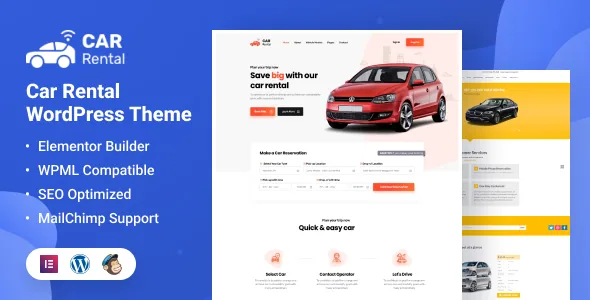
The vendor states this directly in the description, and it is the most consequential sentence for deciding whether the theme fits your business: CarRental ships a Reservation Inquiry form, not a WooCommerce store. A visitor describes what they need, and a sales representative contacts them to complete the booking.
That changes how the site is staffed. Someone has to answer those enquiries, and the outcome depends on the reply, not on the theme. If your rentals business depends on instant payment and confirmed availability, that is not what this landing page does out of the box. It is built to collect requests and route them to a person, so the form, the vehicle presentation around it and the contact routes doing the heavy lifting.
Why the WooCommerce attribute doesn't make it a shop
The marketplace attributes list WooCommerce 6.x.x through 9.x.x as a compatible plugin, and the category is corporate business rather than e-commerce. Read beside the vendor's own note, the two statements describe different things: a compatibility attribute says the theme has been declared to work alongside WooCommerce, not that the rental flow passes through it.
The vendor's description explicitly places reservations outside WooCommerce. So WoCommerce could sit on the site for something adjacent, but you should not plan on a car being added to a cart and paid for on this theme's own pages. If a genuine shop is central to the project, that is a question to settle on a staging copy before design work starts, because the answer determines how much of the theme you actually use.
Vehicle tabs, and the six-car threshold
The vendor's feature list names Vehicle Preview Tabs, a Teaser Image Slider and a plain Image Slider. The changelog adds the detail that tells you most about the tabs: version 1.0.3 records a scroll control in the Vehicle Tab that appears once more than six vehicles are listed.
That is a layout signal worth planning around. The tab area holds a visible set of vehicles and switches to scrolling as the fleet grows. Six cars read as a compact arrangement; thirty require the visitor to scroll inside the tab panel rather than scan a full list. Neither is wrong, but the number of vehicles you actually rent decides which experience most visitors get.
The two slider types do different jobs, and stacking them on one page rarely helps. A teaser slider makes a short visual argument near the top; an image slider belongs further down or inside a vehicle entry. Choosing which photographs appear where is an editorial decision, because the theme presents your images without filling the gaps itself.
Settle the builder question before you write a page
The published material conflicts, and no amount of reading resolves it. The marketplace framework attribute names Unyson. The changelog records version 3.0 as being developed from scratch with the Elementor page builder, and later entries keep following that thread: a 3.6 fix for a deprecated Elementor control, Elementor compatibility updates in 3.0.1, 3.0.3, 4.4, and Elementor-related ongoing maintenance. The vendor's marketing copy still advertises a drag-and-drop visual builder without naming it.
Either the framework attribute is out of date, or part of the theme still leans on Unyson while pages are built in Elementor. The only reliable answer comes from the theme you install and its documentation, which the listing marks as well documented.
This is worth ten minutes. Pages built in one builder do not transfer to another, and a team already comfortable with Elementor would have a very different first week depending on which answer is true.
Holding a visitor who isn't ready to enquire yet
One Page Navigation is listed, and it suits a rental landing page: introduction, vehicles, how it works, contact. Anchor links let someone move within that sequence instead of loading separate pages, which keeps the enquiry form one click away from anywhere on the page.
The supporting capture pieces are ordinary but load-bearing. The vendor lists Newsletter Integration with MailChimp, so a visitor not ready to reserve can still be collected, alongside a working Contact form for general messages and Checkout Autoresponder for messaging around the enquiry process.
Each of those needs configuring with your own accounts and credentials, and the changelog is a reminder of why: separate entries record fixes for the MailChimp API and the Google Map API in 2018. External services break when providers change requirements, not only when the theme is updated, so budget a little maintenance for whichever of these you switch on.
Translation, files and what the listing declares
The ThemeForest file list is PHP, CSS and JS files. Vendor copy describes the theme as built on Bootstrap 3, responsive, with high-resolution assets, 4+ columns and widget-ready areas. Translation is handled two ways: a .pot file for translation-ready strings and WPML listed among compatible plugins. A rental business serving more than one language gets more from that pairing than from most of the feature list.
The marketplace attributes observed on 4 November 2026 declare WordPress 6.0.x through 7.0.x, Firefox, Safari, Opera, Chrome and Edge, and Gutenberg optimisation marked yes. Those are declarations recorded on the listing, not the result of running the theme on a particular server or plugin set, so check the version range against your own PHP build.
One thing the package does not include is the preview photography; the demo images are demonstration content. Fleet photography carries a car rental site, and a tab layout with three vehicles looks nothing like the preview with a full fleet.
Questions & answers
Can a visitor reserve and pay for a car through the theme?
Not through the rental flow. The vendor states the theme ships a Reservation Inquiry form rather than a WooCommerce booking system: the visitor submits an enquiry and a sales representative follows up. WooCommerce appears in the compatibility attributes, which is a declaration about working alongside the plugin, not a description of how reservations are processed.
Do I edit pages with Unyson or Elementor?
The listing disagrees with itself. The framework attribute names Unyson, while the changelog records version 3.0 as a rebuild with Elementor and continues with Elementor fixes in later releases. Confirm which builder your installed version uses before building content, since pages do not move between builders.
What happens to the vehicle tabs with a large fleet?
The changelog entry for version 1.0.3 records a scroll control appearing in the Vehicle Tab when more than six vehicles are listed. The layout is designed around a visible set of vehicles with scrolling for longer lists.