The import screen asks a question before you build anything
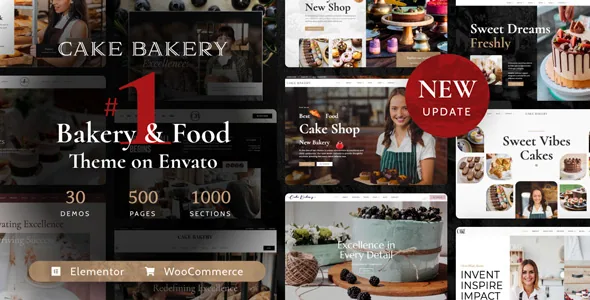
Nicdark's description is unusually candid about the demo import: you choose between two kinds of starting site. The first is a simplified version, described as having no scrolling effects or transitions and no shop section, and the vendor frames it as the option with limited functionality for people new to WordPress. The second is the fuller demo set that includes the shop and the visual effects shown on the live preview.
That is the decision worth thinking about first, because it is harder to reverse than a colour change. Pick the simplified import if you want a brochure site for a single bakery and would rather not maintain a shop you do not need. Pick the fuller import if the site has to sell, and budget the plugin work that comes with it.
What the fuller demos cost you in plugins
The vendor states that demos built with Elementor require Elementor Pro with all widgets included, and that this is not part of the theme package. A parenthetical offers "any other free alternatives" as a substitute, which is the vendor acknowledging that the same layout can be reconstructed with other tools; it is not a promise that a free replacement will reproduce every widget position identically. The same passage notes that plugin licence activation is not mandatory.
Read that as a layout-fidelity question rather than a licensing one. If matching the preview precisely matters, plan on Elementor Pro. If close enough is acceptable, expect to rebuild some sections yourself. The listing also names WPBakery Page Builder among supported tools, and the vendor's own copy refers to demos built across more than one builder, so check the intro page for which builder each demo uses before you commit to one.
Locations, and why a food theme needs a locator
The vendor's feature list devotes a block to locations: add your store branches in a few steps and display them on Google Maps with a preview image. The description of the frozen yogurt and ice cream demo calls the same capability a store locator.
For a bakery with one shop this is a map on the contact page. For a small chain it is the difference between a theme that can list five addresses and one that only has a single contact page. If you run more than one counter, ask how the locations are stored and edited before you assume the demo's version scales to your count.
WooCommerce behind the counter
The vendor describes WooCommerce as the route to selling online, with both physical and digital goods supported and payment through major credit cards, PayPal, BACS bank transfers and cash on delivery. Those are WooCommerce's own capabilities rather than something the theme adds, so the useful question is how much product presentation the layouts carry — cakes, cupcakes, macarons and boxes of chocolate photographed on a plate rather than on white.
The marketplace attribute list, observed on 3 November 2026, declares compatibility with WooCommerce 5.x through 9.x. Treat that as a listing declaration, not a tested combination; if your shop runs a newer major version, stage it before launch.
Sections the theme already has, and the ones you build
Nicdark lists dedicated sections for food businesses: About Us, Services, Prices, a work archive with single pages, a contacts page and a Team section. These are the pages a bakery or café tends to need anyway, and having a price list layout ready saves the fiddly part of a menu-style page.
Layout work happens on a 12-column grid inside a 1,200px content width, per the vendor. Full-width sections can take parallax image or video backgrounds, and video blocks accept YouTube, Vimeo and SoundCloud embeds with options for a cover image, loop behaviour and player controls. Colours are set with a picker, so a patisserie's palette is a settings change rather than a stylesheet rewrite.
Gallery and motion: where the sweet photography lands
The gallery is described as filterable with a masonry effect, images of different heights, hover effects and a jQuery lightbox that opens the picture at full size. For a business whose product is photographed, a masonry grid that tolerates mixed aspect ratios is more useful than a strict square grid, and full-size lightbox viewing is how a customer checks icing detail.
Motion sits in the same part of the theme: slider, carousel and slideshow building through the visual builder, plus a preloader that the vendor says can be recoloured, re-iconed or removed wherever it appears. The simplified demo omits the scroll effects, so if you want the quieter build, you are choosing it deliberately rather than accidentally.
Package contents and the version band
The marketplace file list includes layered PNG and layered PSD files alongside PHP, CSS and JavaScript. The PSDs are the useful part for a brand-specific venue: source artwork for the theme's design elements that a designer can adapt.
Compatibility declarations recorded on 3 November 2026 name WordPress 4.9.x through 6.9.x, Elementor and Elementor Pro, WPBakery, WPML, Contact Form 7, Gravity Forms, WPForms, Events Calendar, Easy Digital Downloads and WooCommerce 5.x–9.x. Gutenberg Optimized is marked Yes, and the package is listed as widget ready with documentation. Both the vendor and marketplace metadata point to Nicdark as the author and a recently updated listing; none of this is proof of how the theme behaves on your server, so confirm the exact combination you intend to run.
Questions & answers
Do I need Elementor Pro to use Cake Bakery?
Not for the simplified demo. The vendor states that the fuller demos built with Elementor require Elementor Pro with all widgets included, which is not part of the theme package, or a free alternative you supply. Choose the demo tier with that dependency in mind.
Can the theme show more than one shop location?
The vendor describes a locations feature that adds your branches in a few steps and shows them on Google Maps with a preview image, and calls the same capability a store locator in the ice cream demo description. Confirm how many locations the setup comfortably handles if you run several.
Does Cake Bakery support selling products online?
WooCommerce is the store layer described by the vendor, covering physical and digital goods and standard payment methods including cards, PayPal, BACS and cash on delivery. The shop section appears in the fuller demos, not the simplified one.