Project pages before project archives
Ambient's portfolio work runs on its own content type with shortcodes around it, and the vendor separates single-project presentation from listing presentation rather than treating one template as the whole system. Single projects come in three named layouts: Gallery, Slider and Images. Listings come as a general Portfolio List shortcode with several layouts, plus dedicated Masonry and Gallery variants.
That split is worth deciding early, because it changes how much you show at once. A Slider layout holds a visitor to one frame at a time, which suits a staged room photograph where you want the sequence respected. An Images layout hands the pacing to the visitor, better for a project with a dozen or more shots and no obvious order. A Gallery layout sits closer to a curated set.
The Portfolio Project Info shortcode handles the facts that accompany the pictures — the details a client scans for before deciding whether to enquire. A Portfolio Slider shortcode gives you the same project content in moving form elsewhere on the site.
Masonry or gallery listing, and the hover treatment
On the archive side you choose between layouts, with masonry and gallery called out separately by the vendor, and various portfolio hover types available. This decision governs every project listing page at once.
Masonry copes with mixed image proportions, which is the normal state of interior photography: a wide kitchen shot beside a tall stairwell detail. A gallery-style layout imposes more consistency, so the grid reads as a set rather than a collage. If you have a large archive and images of varying ratios, masonry is the lower-friction default; if you shoot to a fixed crop, the gallery layout shows that discipline.
Because hover types are also configurable, schedule a pass over them after the first twenty or so projects are in place. Hover behaviour that reads well on a short demo list can get noisy when repeated down a long page.
Header types and the logo files they expect
Three header types are listed — Standard, Full Screen and Vertical — each with three behaviours: sticky, sticky on scroll up, and fixed. Sticky on scroll up and always-sticky are not the same decision. The first keeps the page unobstructed while reading downward and brings navigation back the moment someone scrolls the other way; the second keeps a bar present at all times.
For a studio site that opens on a large interior photograph, the Full Screen or Vertical header buys horizontal room the photography can use. Both come at a cost in assets. The vendor lists multiple logo versions for the mobile header, vertical header and sticky header, plus dark and light variants, with a separate control for logo size on mobile devices. Prepare a small logo set in both weights before you start, because retrofitting a light logo across a dark sticky header late in the build is tedious.
Header widget areas, of which there are several, let you place a phone number, a short practice statement or social icons in the header rather than adding a plugin for it.
Twelve homepages, and the one-page option
The vendor lists 12 contemporary homepages and a set of ready-made inner pages, importable in one click. Rather than comparing twelve designs side by side, choose by opening rhythm: a single full-bleed project image, a tiled grid of recent work, or a split layout with a written statement of practice. Whichever you pick determines what needs to be ready on day one — one strong image, or twenty.
Ambient also supports a one-page site using anchor navigation, which works for a small practice whose about, selected projects, services and contact content all fit on a long page. It stops working well once the portfolio grows, because anchor navigation gives an archive nowhere to live.
Where content lives: builder, shortcodes and widgets
Pages are assembled in WPBakery Page Builder, included by the vendor, with Slider Revolution also listed as bundled for sliders. The theme's own shortcode set covers most of the repeated blocks an interiors site needs: Masonry Gallery, Gallery Blocks, Image with Text, Image Gallery, Item Showcase, Team, Clients Boxes and Clients Carousel, Banner, Call to Action, Social Share, Animation Holder and a configurable Google Map.
A recurring choice follows from that overlap. A gallery can be a shortcode inside a page or a builder element arranged in a row, and clients or team rows can be configured once or repeated per page. Pick one approach per content type and stick to it. Mixed approaches are what make a later redesign slow, because each instance has to be found in a different place.
Widgets extend this: an Instagram Feed widget and a Twitter Feed widget are listed in the theme description alongside Blog List, Author Info and Social Icon widgets. Treat the social ones with caution — the version 2.4 changelog records the removal of the Elated Instagram plugin because of Instagram API changes, and an earlier release removed the Twitter plugin for the same reason. Social integration is a moving target, not a fixed feature.
The blog side offers standard and masonry layouts, six post formats, and Standard or Load More pagination for masonry lists. Typography controls are extensive: five icon font packs and a Google Fonts library the vendor puts at 800+ fonts.
Demo images, declared compatibility and the 2.4 release
The vendor states clearly that the demo images are presentational only and cannot be used on your site unless you buy a licence from a stock provider. For a portfolio theme this is a real scheduling constraint: the photography is the demonstration, so source the images — a shoot, client-supplied project photos, or licensed stock — before importing a demo. That way the import gives you structure to fill rather than a look you have to defend.
As listed by the marketplace on 4 November 2026, the compatibility attributes declare WordPress 6.3.x through 7.0.x, WooCommerce 9.x.x and 10.x.x, WPBakery Page Builder and WPML. Those are marketplace and vendor declarations, not results from running the theme against your plugin set and hosting. The package fields record PHP, CSS and JS files, and the vendor includes a child theme, which is the right place for customisations that should survive an update.
Version 2.4, dated 30 October 2025, added a WPML config file and WooCommerce 10.x compatibility, updated WPBakery and Slider Revolution to the versions named in the changelog, improved Google Map API compatibility, and removed the Instagram plugin. For a shop, the product list, simple product list and product info shortcodes place prints, fabric samples or consultations inside pages while WooCommerce runs the catalogue; confirm that combination on staging with a few real products, since that is where declared ranges meet your actual setup.
Who Ambient suits, and where it strains
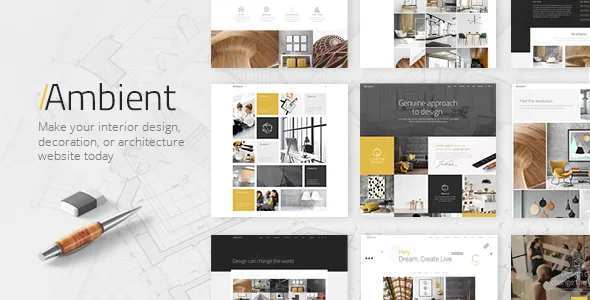
Ambient fits a practice whose work is visual, where the portfolio is the main argument and the rest of the site supports it. The single-project layout choice, the masonry or gallery archive, and the full-screen or vertical header all point the same way: give the images room.
It fits less well as a content-heavy site. The one-page option is for small practices only, and a blog run on standard and masonry layouts is functional rather than a reason to choose the theme. If your site's centre of gravity is long-form writing or a large catalogue, the portfolio machinery is more than you need.
One thing to verify before committing: whether the WPBakery and Slider Revolution builds in your copy stay updateable in the way your maintenance routine expects. The vendor includes both plugins, but plugin updates in this theme arrive through theme releases, so a long-lived site should know how that cadence fits its security process.
Questions & answers
Can I use the demo images on my live site?
No. The vendor states the demo images are for presentation only and must be licensed from a stock image source if you want them on your own site.
Which single-project layouts does Ambient offer?
Three, described by the vendor as Gallery, Slider and Images layouts, with a Portfolio Project Info shortcode for the accompanying project details.
Does Ambient include a shop?
The marketplace declares WooCommerce 9.x.x and 10.x.x compatibility, and the theme lists product list, simple product list and product info shortcodes. Those are declarations rather than tested results, so confirm with a real product set on staging.
Is there an Instagram feed built in?
The theme description lists an Instagram Feed widget, but the version 2.4 changelog records the removal of the Elated Instagram plugin because of Instagram API changes. Plan for a third-party embed or plugin rather than relying on the built-in widget.