Modules are the front page, not a builder canvas
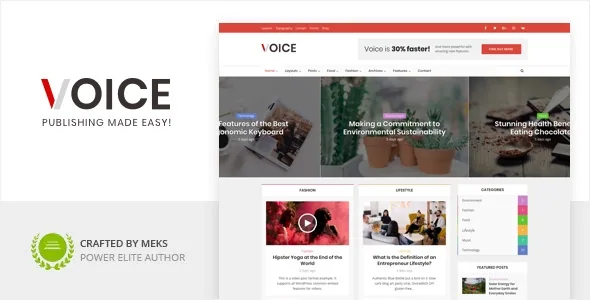
Meks describes Voice around a feature it calls Modules: post listings you stack on a page, each with its own selection rules. Inside a module the vendor's list lets you pull posts from one or more categories, order them by date, view count, comment count or at random, hide anything older than a chosen time difference, or pick posts by hand.
That is a different editing model from dragging content blocks into a layout. An editor builds a section front by deciding which stories qualify, then choosing how that set looks. The vendor says seven main listing layouts combine with three featured-area layouts into more than 150 listing combinations, so the same query can appear as a lead story with thumbnails or as a dense grid.
Ordering by views or comments is where the model earns its keep on a busy portal. A "most read" strip refreshes itself as traffic shifts, without anyone rewriting the page. Random ordering works for weight-neutral slots, and the age filter stops a stale featured block from sitting there for weeks.
Smart Categories let each desk look different
WordPress normally gives every category archive the same template. Voice's Smart Categories let you set a layout, a colour, a featured area, a pagination type and a posts-per-page count separately for each category.
On a publication with several desks, that turns into visible structure: sport can open with a wide featured area and a short page count, while a culture section runs a tighter list. Colour per category gives readers a cue about where they are without extra template work.
The practical cost is consistency. Every category you customise is a place where the site can drift, so decide early which categories get their own treatment and leave the rest on the default. The vendor frames this as flexibility; treat it as a maintenance budget.
Pagination is assigned per page, not site-wide
Voice offers four pagination types: classic older/newer links, numbered pages, a load-more button and infinite scroll. The vendor states the choice is not limited to a global setting, so different pages can use different methods.
That flexibility matters for advertising and for how long a reader stays in a section. Load-more and infinite scroll keep someone on the same URL, which suits browsing but complicates ad impressions and analytics for anyone who reports on pageviews. Numbered pagination is easier to reason about when you are selling placements by page.
The vendor also lists continuous loading on single posts, which continues into the next article as the reader scrolls. If you rely on per-article metrics, check how that interacts with your measurement setup before switching it on.
Ad placements and multi-page posts, as the vendor frames them
Meks includes a banner ads system for the homepage, archive pages and single posts, described as usable without writing code. A Voice Adsense widget accepts an AdSense script and, per the vendor, any JavaScript-based ad service; a separate Meks Easy Ads widget and a Meks Smart ThemeForest widget are listed for placements and affiliate links.
A second feature is post pagination inside an article, which the vendor presents explicitly as a monetisation tool: splitting a long post across pages to raise pageviews and ad impressions. That is the vendor's framing, not a neutral recommendation. Multi-page articles can also frustrate readers who want to finish a piece, and search engines handle them inconsistently depending on how your permalinks and canonical tags are set.
Decide placements before you build the templates. The theme makes it easy to drop banners into three content contexts, and the risk is not technical difficulty but an over-filled page.
Category modules, custom post types and sidebars
Category modules let you list categories the way you list posts, in one-, two- or five-column displays, with an optional slider on any variation. For a portal with a long section list in the footer or a directory page, this replaces manual link building.
Modules also detect registered public custom post types, per the vendor. If you run reviews, listings or a video library as its own post type, those items can appear in the same module system rather than needing a separate plugin shortcode.
Sidebars are unlimited, and a specific sidebar can be assigned to any post, page or category. Sticky sidebars can be applied per template so widgets stay visible as the reader scrolls. On a news site that usually means a long-running ad or a most-read list that follows the reader down a column.
What the package claims, and what its release history shows
The listing declares WordPress 4.9 through 7.0 support and WooCommerce 5 through 10, alongside bbPress support, RTL support, post formats for video, audio, image and gallery, 12 shortcodes, and included documentation plus demo content. Those are vendor and marketplace claims, not results from running the theme on a particular server.
The video plugin, forum plugin and shop plugin are declared integrations. WooCommerce support does not mean a finished storefront, and bbPress support does not mean a configured community; both still need setup.
The release history is the part to weigh. The marketplace's most recent entry, 3.0.3, dates from August 2023, and its notes cover TikTok, Truth and Mastodon social icons, testing against WordPress 6.3 and PHP 8, and minor styling fixes. Nothing in the supplied record documents testing against the newer WordPress versions the compatibility list now names. Before adopting Voice, check how the current package behaves on your WordPress and PHP versions and whether its options still run cleanly on a fresh install.
A demo import gives you a site resembling the vendor's demo with placeholder content to adapt, which is useful for evaluating the module system quickly.
Who this model suits
Voice fits an editorial team that thinks in sections and queries: a front page assembled from a hero, a most-read strip and several category blocks, each with its own rules. The module system carries that workflow without a page builder, and Smart Categories extends the same logic to archive pages.
If your site depends on a visual, block-driven page builder, this is not the theme's centre of gravity, and the vendor's customisation story sits in Theme Options rather than in editor blocks. The honest test is to build one section front with real stories and see whether the query rules produce the page you pictured.
Questions & answers
Can Voice build a front page without a page builder?
Yes. The vendor's Module system lets you stack post listings on a page, each with its own category selection, ordering, age limit or manual picks, and then choose one of the listed layouts for each module. The supplied description credits the customisation to a Theme Options panel rather than a builder.
Does Voice support advertising placements without editing templates?
The vendor lists a banner ads system for the homepage, archive pages and single posts with no coding required, plus a Voice Adsense widget that accepts AdSense or other JavaScript ad scripts. Where the banners appear within those templates depends on options the description does not detail.
What does a multi-author newsroom get?
The vendor lists support for the Co-Authors Plus plugin to assign multiple authors to one post, a Smart Author widget for displaying author profile information, and an author section in the theme options. These are plugin integrations and widgets, not a bundled editorial workflow.