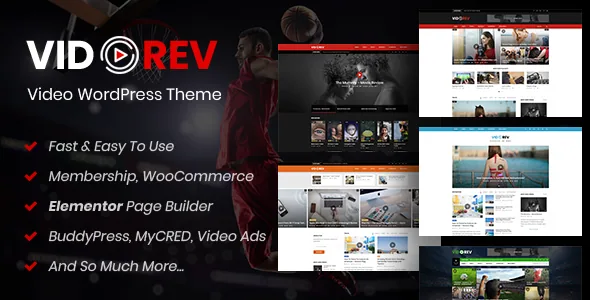
The video arrives with its metadata attached
Most video themes give you an embed field and a thumbnail box to fill in yourself. BeeTeam368's feature list for VidoRev describes the opposite: paste a network URL, let the theme detect which service it belongs to, and the post arrives with its fields already populated.
The vendor is specific about what each network yields. YouTube brings thumbnail, title, description, tags, duration, view count, like count and dislike count. Vimeo supplies the same set minus dislikes, and the listing adds "private video supported." Dailymotion and Twitch stop at view count, Facebook at likes, and Google Drive gives you only thumbnail, title and duration. Read those lists as editorial workload rather than feature volume: a catalogue built on Drive-hosted files leaves you writing descriptions and tags yourself.
Auto Detect Video Network sits in the same list as Self-hosted Video Support, which tells you the ingestion path and the own-files path are treated as two distinct arrangements rather than one default with an add-on.
API credentials are part of the project, not an afterthought
The API block names a data API and a player API for several networks: YouTube Data API V3 with the YouTube Player API, Vimeo Data API V3 with its player API, Twitch Data API V5 with the embedded player, plus Dailymotion, Facebook Graph API V2 and Google Drive API V2. VidoRev Library Control Google Drive Video is listed separately, suggesting the theme manages Drive library content rather than handling Drive playback on its own.
Every one of those services expects credentials you obtain and maintain. That is the real decision point for a VidoRev project: who holds the API keys, which quota they draw on, and what happens to the publishing flow when a key lapses. The theme pulls the data; it does not remove the dependency.
For bulk work, the vendor points at third-party importers rather than claiming the theme does it alone. WordPress Video Robot, Youtube Videos To Wordpress Posts and WordPress Automatic Plugin are all described as routes for pulling YouTube and Vimeo channels into posts, and a TMDB Movie Import is listed with a tutorial reference alongside them.
Three player styles, and ads that follow the video
The vendor lists three player styles with autoplay and auto next, then repeats that trio — autoplay, auto next, pre-roll ads — across the video lightbox gallery and the playlist as well. Pre-roll advertising is specified as running through Google Interactive Media Ads (IMA) SDK for HTML5.
So the monetised video is not only the one on a single post. A visitor who opens a lightbox from an archive, or who lets a playlist run, meets the same ad layer. The lightbox adds Suggested Posts and Live Comments to that, which is a viewing-screen decision: keep people in the lightbox and give them somewhere to go next.
Changelog entries reference FluidPlayer versions across multiple releases (3.21.0, then 3.25.0) and a 2021 fix for the video ad unmute button, which points at a self-hosted player stack kept in step with third-party libraries.
Self-hosted files get their own route
Self-hosted Video Support is a listed feature, not an inference, and the changelog shows what maintaining it has involved: encrypting the video link in HTML for self-hosted videos used with FluidPlayer, and a 2022 fix for the lightbox failing under PHP 8.
That matters if you plan to serve files from your own server or storage. The vendor also records compatibility with WP Offload Media Lite for the front-end video submission form, so the submission path was adjusted with external storage in mind. Whether your own configuration behaves the same is something to establish on a staging copy.
A community layer around the library
VidoRev is set up for visitors who contribute. The feature list names front-end submission for four things — video, post, playlist and channel — with video moderation and video report for the posts that come in. Channels and Subscriptions sit above that, so the site can read as a set of creators rather than a single feed.
Rewards and gating run through named plugins: myCRED, Social Locker and Multi-Links, plus a User Ads Settings area. Video Series groups clips into sequences, and YouTube Live Broadcast is listed for live events. Comments can run through Facebook or Disqus, with Facebook SDK language switching.
BuddyPress and bbPress appear as declared compatibility (BuddyPress 9.x.x and 10.x.x, bbPress 2.5.x and 2.6.x). The changelog tracks Youzify updates repeatedly, which suggests the social-profile side is where that integration work has concentrated.
How archives and discovery are configured
Pagination is listed four ways: page numbers, infinite scroll, a load more button, or prev/next. That is a choice you make per site rather than a single fixed pattern, and it changes how a long video archive feels.
Beyond that, the vendor names sticky video behaviour, video actor and video director fields, an IMDB rating plugin, unlimited overlap colours for theming, support for 700+ Google Fonts, RTL support and a megamenu. Widget-ready sidebars, a one-click demo import and translation readiness round out the declared setup, and WPML is listed under compatible with.
Elementor and Elementor Pro are also declared compatible, and the changelog records Elementor fixes going back to a control-registration deprecation. The marketplace records Gutenberg Optimized as No; treat that as a statement about the theme's block-editor design intent, not a claim that the block editor cannot be used.
What the 2025 fixes say about older copies
The most recent changelog entry, dated 1 December 2025, reads "Fix: Local File Inclusion (LFI)." The release before it fixes unauthorized access through a missing capability check in the vidorev_import_single_video function. Those are the vendor's own words, and they describe patches shipped in those versions.
If you are working from a copy of VidoRev that predates them, the practical reading is that the fixes exist upstream and older builds do not contain them. No third-party copy should be assumed to carry the same patches simply because it shares a name.
The changelog also shows steady housekeeping: CMB2 and Youzify updates, compatibility work for BuddyPress 12, a Contact Form 7 tag-function fix, and PHP 8 repairs to playlist and lightbox behaviour. The two 2025 entries target specific functions rather than a broader refresh, so the pattern is a theme being kept patched while its underlying structure stays fixed.
Reading the declared attributes before you commit
The marketplace attributes captured on 4 November 2026 declare WordPress 4.9.x through 7.0.x, WooCommerce 5.x.x through 9.x.x, bbPress 2.5.x and 2.6.x, BuddyPress 9.x.x and 10.x.x, plus Elementor, Elementor Pro and WPML, with Underscores as the framework. What they leave open is just as worth noting: PHP is not specified anywhere, and a long WordPress version range does not describe what the newer endpoints were tested against.
The feature list also names integrations without pinning versions to them — myCRED, Social Locker, Multi-Links, Disqus, Facebook, Twitch, Dailymotion and the TMDB import appear as capabilities. Third-party plugin changelogs are the place to check whether they still line up with the theme's code. A declared integration is not a guarantee for every demo, and the versioned compatibility list is the more precise signal to plan around.
Questions & answers
Do I need API keys to publish a video in VidoRev?
For content pulled from YouTube, Vimeo, Twitch, Dailymotion, Facebook or Google Drive, the vendor lists a corresponding data API and player API, which normally means credentials you register with the service. Self-hosted video is listed separately, so a site built only on your own files follows a different path than a networked one.
Does VidoRev bill itself as a Gutenberg theme?
The marketplace records Gutenberg Optimized as No. That attribute reflects how the vendor built the theme, not a restriction on using the block editor, and Elementor is separately declared compatible.
Can visitors upload their own videos?
The vendor lists front-end submission for videos, posts, playlists and channels, together with video moderation and video report tools. Those are vendor claims about the submission workflow, so confirm the settings and approval steps on a staging install before opening a site to the public.