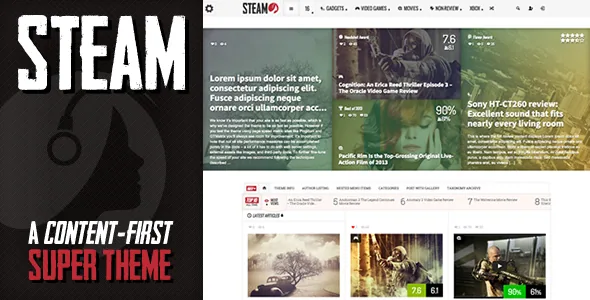
One install, several magazines
Steam's organising idea is the minisite. The theme's own metadata says it lets you create an unlimited number of custom minisites, and the vendor's feature list builds the rest of the product around that: a page builder for the front page, archive pages and standard pages that is "unique for each minisite", a mega menu that dynamically loads posts for minisites, taxonomies, categories and tags, and a one-click minisite builder inside the theme framework.
Read that as a publishing decision rather than a layout option. If you run a gadget site, a film site and a music site under one brand, each section can carry its own front page arrangement and its own primary taxonomy while sharing the WordPress install, users and theme options. A single-publication review theme gives you taxonomies for that; Steam gives you separate editorial units that are wired into the widgets and navigation.
The widget inventory is where the model becomes visible. Latest Articles can pull from a specific minisite, all minisites or all articles and can be limited by category or tag. Sections shows the latest articles from selected minisites in tabbed format with the minisite icons as tabs. Reviews lists latest reviews from chosen minisites. If you only ever publish one title, these options collapse into ordinary category queries — they cost nothing, but they are not why you would choose this theme.
How the rating system actually shapes publishing
The vendor describes a review and rating system built into the theme framework rather than bolted on through a plugin. Scores can be displayed as stars, numbers, percentages or letter grades, and criteria can be weighted, so a score can reflect that build quality counts for more than packaging.
Editor ratings and user ratings can run separately or one can be the only one used, and reviews can be ranked by either. That is a consequential setting for a magazine whose authority rests on staff verdicts: you can publish a staff score and still let readers submit their own totals through comments, where the vendor says users can create detailed reviews. The interface claims live AJAX updating of the user total and unlimited star colours.
The vendor also states full Google rich snippet and schema.org review integration. Treat that as a design intention recorded in the product description rather than a guarantee of how a search engine will display your pages today — structured-data handling has moved a long way since this listing was last updated.
Rankings, sorting and the numbers behind them
A scored publication lives or dies on its lists, and Steam ships several ranking surfaces. The vendor names a Top Ten carousel that ranks posts using several metrics over a specified timeframe, a Top 10 widget version of that slider, a Top Reviewed widget for a designated recent period, and a Trending Articles widget that displays sortable trending posts in bar-graph style with metric counts.
Post loops can be re-sorted through AJAX controls across seven orderings: most recent, most liked, most viewed, highest editor rated, highest user rated, most commented and most awarded. Views and likes are tracked with live AJAX updating, and the awards system lets you define your own badges — an editor's choice mark, a value pick, a genre-specific citation.
The slider layer sits on top of those mechanics: a featured carousel built on Slider Revolution with three predefined layouts and video embedding, a Trending carousel with AJAX filter controls, and carousels with hover navigation. They are presentation for the ranking data, which is why the sorting and metric widgets matter more than the count of sliders.
Directories and author pages
Steam includes minisite directory templates in two types, four styles and two layouts, plus an author listing template that can include or exclude people by role or username. For a multi-title magazine these are the pages that let a visitor move between sections and see who wrote what.
The evidence here is thinner than for the ratings and widgets — the vendor lists the templates but does not describe their contents. If contributor attribution or a browsable section index is central to your plan, look at those templates in the demo rather than assuming what they contain.
What ships, and what the demo borrows
The file list on the marketplace includes PHP, CSS and JavaScript files alongside layered PNG and layered PSD artwork, which is useful if a designer needs to adapt the visual assets rather than rebuild them. The vendor provides a .po file for translation.
One point about imagery deserves attention before you plan a look. The vendor states that the photos in the live preview were purchased for the demo and are not included, and that the demo XML contains placeholders instead so you can drop in images you have the rights to use. Your site will look like the preview only after you supply photography.
On environment, the compatibility attributes recorded on the listing in November 2026 name WordPress 4.3 through 4.9.x, BuddyPress 1.7.x and 1.8.x, WooCommerce 2.0.x and Bootstrap 2.3.x, with browsers listed as IE9, IE10, Firefox, Safari, Opera and Chrome. The vendor's last recorded update is 23 August 2018. Those are declarations attached to the product, not a tested pairing with a current WordPress release, so check the theme against the version you actually run before committing to it.
The decision this theme asks you to make
Steam is built for a publication that publishes scores, ranks them and organises them into more than one section. The mini site structure, the four score formats with weighted criteria, the editor-versus-user split and the metric-driven carousels all serve that one workflow, and they are the reason to pick it over a general magazine theme.
What it does not offer is a modern editing baseline: the vendor does not mark it Gutenberg optimized, and the declared WordPress range stops well behind current releases. If you need the block editor as your main composition tool or a theme maintained against recent WordPress versions, this product will read as a legacy choice. Settle that question first — the rest of the feature set is coherent once it is answered.
Questions & answers
Can I run more than one review section on a single Steam install?
Yes, that is the theme's central structure. The vendor describes unlimited minisites, each with its own page-built front page and primary taxonomy, and provides widgets that can pull articles and reviews from one minisite, several, or the whole site.
Which score formats does the built-in rating system support?
Stars, numbers, percentages and letter grades, according to the vendor's feature list. Criteria can be weighted, and editor ratings and user ratings can be published separately or with only one of them active.
Are the preview photos included with the theme?
No. The vendor states that the images used in the live preview were purchased for demo use and are not part of the theme files, and that the demo XML uses placeholders so you can substitute your own licensed images.
Which WordPress versions does the listing declare support for?
The compatibility attributes observed in November 2026 span WordPress 4.3 through 4.9.x, with the vendor's last recorded update in August 2018. That is a vendor declaration rather than evidence of testing on a current WordPress release.