Demos are the starting point, not a blank canvas
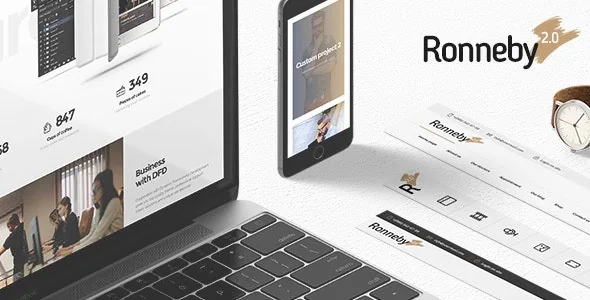
Ronneby, from DFDevelopment, is built around starting from finished sites rather than an empty theme. The vendor's description lists 50+ pre-built demos across creative, corporate, blog, portfolio, gallery, shop and one-page categories, with named examples including Restaurant, Lawyer, Agency, Health Care, Fitness, App, News and Portfolio. Import is handled through the theme's one-click demo installation.
That model sets the shape of a project. When you install a demo, you take on its page structure, header treatment and section ordering, then edit from there. For a site that closely resembles one of the listed niches, this saves the structural work. For a site that doesn't, the demos function as reference patterns rather than a head start, and you spend your time deleting and rebuilding sections instead. The published demo site is worth a look before you commit, since it shows what the demo set actually looks like rather than what the category labels suggest.
The WPBakery path: front-end editing with DFD shortcodes
The primary authoring surface is WPBakery Page Builder, which the vendor says is bundled with the theme alongside Slider Revolution and other premium plugins. Editing happens in a drag-and-drop visual editor with a front-end view, so you arrange rows and columns in something close to the rendered page.
On top of the builder sits a set of 40+ DFD custom shortcodes. These are the theme's own modules — the elements that carry Ronneby's styling and behaviour rather than generic builder blocks. Front-end editing plus bespoke shortcodes is a coherent authoring workflow, but it has a maintenance consequence worth naming: page content built from shortcodes is stored as shortcode markup, so a page's structure lives in that module system. If you later want to move those pages to another theme or rebuild them in a different editor, expect to reconstruct the sections rather than carry them across.
These are the vendor's descriptions of what is bundled. What a particular copy of the theme includes is a separate question from what the marketplace description advertises.
Elementor runs alongside, with its own import files
Elementor appears in the vendor's compatibility list, and the changelog shows it is more than a passing mention. Entries across 2022 and 2023 add Elementor widgets — Timeline, Countdown, Pie chart, Price list, Gallery, Team Member Carousel, Milestone and icon list among them — and note Elementor import files being added to the package. Later releases continue the pattern, including a "Ronneby portfolio" Elementor layout in version 3.5.72 and compatibility fixes for Elementor 3.26.*.
So Ronneby supports two builder paths rather than one, but they are not symmetrical. The demo library and the 40+ DFD shortcode set are described in the context of WPBakery, and the changelog's Elementor entries read as additions layered onto that base. If you already work in Elementor and want its widget ecosystem, the track exists; if you want the full demo catalogue as designed, WPBakery is the path the vendor documents. Mixing the two across a site adds a second editor to maintain, which is worth deciding against deliberately rather than by accident.
Where the block editor fits
The marketplace listing records Gutenberg optimization as "No", and the vendor description documents WPBakery and Elementor authoring rather than block-based page building. That attribute is a statement about optimization, not a switch that disables the block editor on your site — but it does mean the theme's documented workflow, its demo imports and its custom modules are not aimed at block-first authoring. If your team plans to build pages primarily with core blocks, you would be working against the grain of how this theme is set up.
Maintenance signals in the changelog
The changelog shows steady upkeep rather than a theme left to sit. Recent entries fix WordPress 7.0 compatibility bugs, address PHP 8.4 compatibility, and update WooCommerce templates — the kind of work that keeps a theme aligned with the platforms underneath it. Earlier entries show the same pattern over a long run: repeated WPBakery and Slider Revolution updates, Ronneby Core plugin revisions, WPML and bbPress compatibility fixes, and Polylang language-switcher work.
The vendor's stated WordPress compatibility spans 5.5.x through 7.0.x, as recorded in the marketplace listing observed on 3 November 2026. Read that as the vendor's claim about supported versions, not as a record of testing on this site. Two practical notes follow from the maintenance history. A theme with a bundled plugin stack and its own core plugin means updates arrive as a group, so plan for them rather than treating the theme as install-once. And because the changelog pairs builder updates with compatibility fixes, an out-of-date copy is more likely to break against a current WordPress or PHP release than a current one.
WooCommerce and multi-language, as vendor claims
Ronneby's compatibility list names WPML, bbPress 2.5.x, Elementor and Facebook, and the changelog shows recurring WooCommerce template updates — evidence that the shop side is actively maintained rather than a static inclusion. Language work appears through both WPML fixes and a Polylang language-switcher compatibility entry. These are vendor statements about compatibility; they don't tell you how a specific plugin combination will behave on your server, so test the pieces your project actually depends on.
Questions & answers
Do I need WPBakery to use Ronneby, or can I build entirely in Elementor?
Elementor is listed as compatible and the theme ships Elementor widgets and import files, so an Elementor-only build is a documented path. However, the 50+ demos and the 40+ DFD shortcode set are described around WPBakery, so a site built purely in Elementor won't get the full demo catalogue as designed. If matching the demos matters, use WPBakery.
Can I use core Gutenberg blocks to build pages with Ronneby?
The listing records Gutenberg optimization as "No" and the vendor documentation covers WPBakery and Elementor authoring. The block editor isn't disabled, but it isn't the workflow the theme's demos and custom modules are built for.
What happens to my pages if I later switch themes?
Pages built with DFD shortcodes store their structure as shortcode markup, so sections usually need rebuilding in another theme or editor rather than carrying across cleanly. Factor that in if the site may change design systems later.