Property work happens on the front end, not in wp-admin
Most real-estate themes are a set of templates wrapped around a listings plugin. Real Spaces is organised differently: the vendor's feature list gives equal billing to "Front End Property Submission Page" and "Front End Agent Profile Management." Adding a property and maintaining an agent profile are public-side tasks in this theme, not administrative ones.
That shifts the design question. You are not only choosing how a property card looks; you are deciding which of your users gets a form, what fields that form asks for, and how much of an agent's public identity they control themselves. The vendor's demo notes point to the same area, offering a demo login to inspect the add-property page, the agent profile edit page and the agents property page.
If your team already works comfortably inside the WordPress dashboard and you simply want attractive listing pages, that architecture is more machinery than you need. If estate agents, outside brokers or individual sellers are expected to publish their own stock, it is the part worth evaluating first.
The front-end dashboard gives logged-in users one place to look
Version 2.5, dated 4 October 2018, added the Real Spaces Dashboard so users could see their items "in a single place." Read alongside the submission and profile features, that suggests a logged-in area collecting a user's properties and account actions rather than sending them back to wp-admin to check status.
The changelog also shows this surface receiving attention rather than being left as a launch feature. Version 2.3 added a success message after a front-end profile update; version 3.4, from October 2024, fixed a reset password form; version 3.6.1, from August 2025, patched what the vendor describes as a potential security bug in the agent registration template, with a similar fix in the agent profile template the release before.
Those last two entries matter more than they look. Registration and profile edit forms are where outside users hand you data, so a theme that keeps a maintained record of patching them is doing the work an agent directory actually requires.
Listing functionality lives in a companion plugin
Since version 2.6 in May 2019, the property features have shipped inside a separate Real Spaces Core plugin — the vendor's stated reason being WordPress's standards for separating theme functionality from presentation. Many later changelog entries are Core plugin updates rather than theme updates.
Practically, plan for two moving parts. The theme handles presentation; the Core plugin carries the directory behaviour. That is the more maintainable arrangement, but it also means the property side does not update just because you replace the theme, so treat both as a pair when you deploy a new build.
Around submission sits a commercial layer. The changelog references a property payments plugin and fixes to payment plans, including a July 2025 correction to a payment plans options field. Version 1.8 added the option to enable property submission for buyers as well, which widens who can post beyond agents. Whether you charge for listings or let everyone publish for free is a settings decision the theme supports rather than a default you are locked into.
Design control sits at scheme and layout level
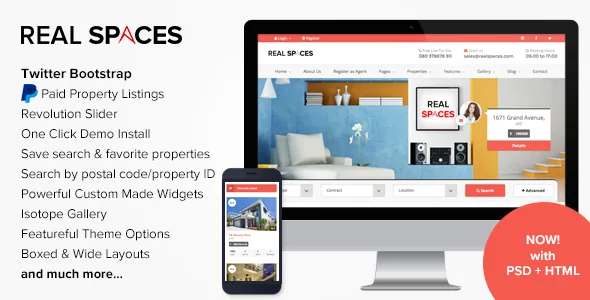
The appearance options are stated plainly: ten prebuilt colour schemes with further colour settings, boxed and wide layouts, and a list/grid toggle for property archives. Galleries use Isotope, sliders use Revolution Slider, and the type layer is Font Awesome icons with Google Fonts.
This is a directory theme's approach to design: global switches and per-page templates rather than assembling every page from blocks. A property directory gains more from a consistent card, a readable search result and a dependable grid/list switch than from unlimited layout freedom, and styling here is confined accordingly. If you want to redesign individual property pages section by section in a builder, look for a theme built that way instead.
WPML and the stated WordPress range
The marketplace attributes recorded on 4 November 2026 list WPML under Compatible With, alongside a WordPress version range running from 5.0.x to 7.0.x, and responsive layout with four or more columns. The vendor's changelog points at the same direction, with version 3.8 noting compatibility with WordPress 6.9+ in February 2026.
WPML matters most for a directory that serves more than one language market, since property types, locations and agent bios all need translating, not just page copy. The compatibility entry is the vendor's declaration; it does not describe how translated property records behave in practice, so verify that on your own setup if multilingual listings are central to the plan.
One inclusion note from the vendor's credits: images in the live preview are not part of the theme, so the photography in any demo you like has to be replaced with your own or licensed separately.
What the release history tells you about upkeep
The changelog runs back to 2015 and continues to recent releases, with a steady cadence of Core plugin and Revolution Slider updates and periodic WordPress compatibility notes. That pattern is the useful signal here: a directory theme ages through its forms, search filters and payment logic, and these are the entries that keep appearing.
It is not a guarantee about the build you hold. Version numbers, fixes and compatibility claims come from the vendor's own changelog, not from independent testing, so check the release number in the material you receive against the fixes listed there before assuming a specific correction is present.
Questions & answers
Can buyers submit properties, or only agents?
The vendor's changelog records an option added in version 1.8 to enable property submission for buyers as well as agents. Who can post depends on that setting and on the payment plan configuration you use.
Do I need the Real Spaces Core plugin as well as the theme?
Yes. Since version 2.6 the property functionality has been delivered in a separate Real Spaces Core plugin, and much of the subsequent changelog consists of Core plugin updates. Plan to treat the theme and plugin as a matched pair.
Is there a page builder for property pages?
The vendor describes a directory theme with templates, colour schemes, boxed or wide layouts and a list/grid view, not a drag-and-drop page builder workflow. Page-level design freedom is limited compared with builder-based themes.