A magazine theme whose real control surface is the post block
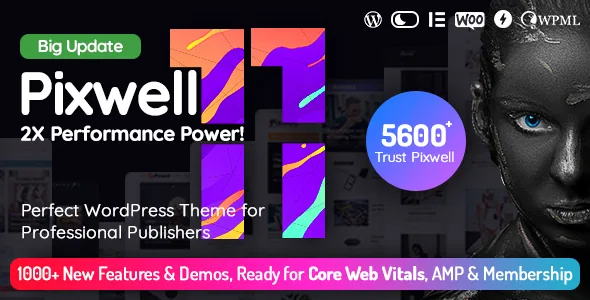
Most magazine themes sell a homepage arrangement. Pixwell's vendor description puts the emphasis elsewhere: an Ajax system that lets you add filter types into the block header, so a visitor can narrow posts by category, tag or author without leaving the page. Pagination is a choice too — load more or infinite scroll — and live search sits in the header.
That combination determines how a site actually behaves once it has a few thousand posts. A section page built from filtered blocks becomes a browsing surface rather than a reverse-chronological list, and the editor decides upfront how deep a reader can go before the page stops offering more.
Theme-Ruby also slots two reader tools into this layer. Read It Later lets visitors bookmark posts for a later session, and Post Reactions records a response to a post. The vendor describes both as unique to Pixwell, which is a claim about the theme, not a guarantee about your visitors' willingness to use them.
Retention features and the ad slot attached to them
Infinite Single Load Next Posts continues into the next article without a full page load. The vendor gives three settings that matter more than the effect itself: tracking through Google pageviews, choosing the next post by category, and placing custom advertising in the sidebar for each load.
That third option is the interesting one. It means the ad inventory grows with reading depth, so a long reading session produces more ad impressions without more layout work from you. Whether that suits your site depends on how aggressive you want the continuation to feel — a reader who never returns to the archive also never sees your category navigation.
The vendor's newsletter system follows similar logic: a popup, a live confirmation when someone subscribes, and export of collected addresses to a file. MC4WP is supported as an alternative. Because the data export comes built in, the subscriber list stays portable rather than locked into a third-party service.
Ad placement without a separate ad plugin
Per the marketplace description, responsive AdSense placement is built in, with sizes selectable separately for laptops, tablets and phones. In-feed ads insert inside the post feed, which puts a unit between articles instead of in a sidebar rail.
The version 11.6 changelog entry notes improved ad-block detection working with modern blocking extensions. Read that as the vendor's statement about the theme's behaviour, not as a way around a visitor's choice to block ads — detection tells you impressions may be missing, it does not restore them.
For a publication that already runs a dedicated ad manager, these settings duplicate existing work. For a smaller editorial site, having placement in the theme options removes one plugin and one integration decision.
Ruby Composer or Elementor: two routes into the same site
Pixwell ships with its own builder and supports another. Ruby Composer is described as a lightweight drag-and-drop builder with predefined templates that create a page in one click — pitched at people new to WordPress. Elementor support is stated as full compatibility across all layouts, which matters if your team already builds in Elementor and does not want to learn a second interface.
The distinction worth thinking through: Ruby Composer is the vendor's own layer and its templates are the ones the demos were composed from. Elementor gives you an ecosystem of third-party add-ons and a workflow you may share with other sites. Mixing both on one site is technically possible, but it splits your editing conventions, and whoever maintains the site later will need to know which pages belong to which tool.
The demo library is broad, and imports can be partial
The vendor lists more than thirty prebuilt site names: recipe, fashion, technology, travel, minimalist blog, portfolio, food review, gadget review, deal and coupon variants, sport, interior, beauty, medical, yoga, digital marketing, gaming, podcast, cryptocurrency, military, software, wedding, architecture, local breaking news, and more. Two entries are worth singling out because they are not niches: RTL Language and Mobile AMP.
Import happens from the theme options panel, and the vendor states you can take everything or select individual options and widgets. That granularity is the practical detail — it lets you pull a layout without overwriting settings you have already configured.
Breadth of demo names is not breadth of finished design. Each demo is a starting arrangement; the content that makes it look like a magazine is yours to produce.
What a single post can carry
The vendor lists 5+ single post layouts supporting video, gallery, audio and standard formats, with sponsored posts, self-hosted media and GIFs named specifically. There is also a built-in review system with custom meta values, a table of contents for long reads, and a gallery lightbox that shows caption, title and description.
Two additions extend the format set: a custom gallery post type and a custom portfolio post type. For an editorial site, the gallery type is the more immediately useful of the two; the portfolio type makes more sense on a personal or photography site mixing articles with project pages.
Inline related posts via shortcode place related content inside the body rather than after it, and the Shop The Post feature embeds shopping items or affiliate code in a single post — the vendor positions it for fashion blogging.
Dark mode, typography and the performance claim
Dark mode is available as a visitor-facing switch, and the vendor says it can also be set as the default site layout. Default matters for a reading-heavy site: a dark default changes the first impression and how photography and featured images sit against the page.
Styling is managed from a Redux-based theme options panel with options for typography, colours and element styling, and the vendor says the full Google Fonts library is available for individual elements. A newer changelog entry adds local font uploads — relevant if you would rather serve fonts yourself than call Google.
On performance, the vendor says the theme stores additional post meta in a single meta field and loads functions modularly. That is a design statement about database and loading behaviour, not a measured benchmark; the number that matters is the one your own hosting and plugin stack produce.
Declared compatibility, as observed 3 November 2026
Marketplace attributes observed on that date list WordPress 5.5.x through 7.1.x, WooCommerce 6.x through 10.x, Contact Form 7, Elementor, Elementor Pro and WPML, with Gutenberg Optimized marked yes and PHP, CSS and JS files in the package. AMP support is described by the vendor as working in the plugin's transitional mode across default templates.
These are vendor and marketplace declarations, not the result of running this theme against your server. Before committing, the relevant test is a staging install with your PHP version, cache setup and plugin list — particularly if you depend on a page cache or a multilingual configuration.
GDPR cookie notice is built in, so a separate consent plugin is not required for that one job; a full consent workflow covering analytics and ad scripts is a broader question the theme does not answer for you.
Questions & answers
Do I need Elementor to build pages with Pixwell?
No. The theme bundles Ruby Composer, its own drag-and-drop builder with predefined one-click templates, and the vendor describes Elementor as an additional supported route rather than a requirement.
Can readers keep track of posts across visits?
The vendor includes Read It Later, which lets visitors bookmark posts and return to them, alongside Post Reactions for responding to a post. Both are presented as features specific to Pixwell.
Can dark mode be the default rather than an option visitors toggle?
According to the vendor, yes — dark mode can be switched on by the visitor or set as the default site layout from the theme settings.
Does importing a demo replace my existing settings?
The vendor states the theme options panel lets you import everything or select only individual options and widgets, so a full overwrite is a choice rather than the only path.