A theme organised around the player, not the page builder
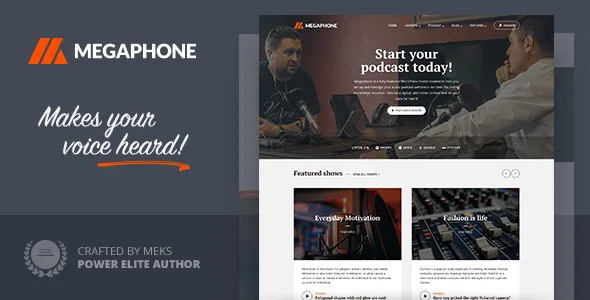
The vendor's description of Megaphone puts audio distribution first. It names Spotify, iTunes, SoundCloud, MixCloud, Stitcher, PodBean, Blubrry, Libsyn, Spreaker, Cadence, Podomatic and Deezer, then adds "and many more". In practice that means the theme's own player is meant to pull an episode's audio from wherever it is already hosted, so you are not forced to re-upload every file into WordPress.
The changelog shows the direction that list grew in. Version 1.2 rolled out support for Simplecast, iHeart, TUNEIN, Anchor.fm and Ausha embeds, alongside icons for Overcast, iVoox, BuzzSprout and others in the Subscribe menu. Later releases added Amazon and Rumble, and 1.2.2 added Castos, a hosting provider. Each is an embed or a subscribe link, configured under Theme Options → Podcast → Player.
No page builder is named anywhere in the supplied listing. If the builder your team edits in matters more than the player, that is a question to settle against a live demo rather than from this description.
Episodes are meant to be separate from posts
A podcast site usually needs a blog as well, and the two content streams behave differently: one publishes on a numbered schedule, the other on whatever rhythm the writing takes. Megaphone addresses this with a setting that controls how episodes are separated from ordinary posts, and the changelog is unusually frank about it.
Version 1.1 added an option to switch that separation logic for sites running Podlove or Seriously Simple Podcasting, two established podcasting plugins. Version 1.5 then fixed a WordPress 5.8 problem that broke specific settings for splitting episodes from blog posts. So the theme expects you to decide, early, whether episodes come from its own episode content and templates or from a plugin's feed, and the setting exists to keep the blog from filling up with episodes.
Version 1.3.2 also added a standalone Episodes listing page template, which gives you a page dedicated to the archive rather than relying on the front page alone.
Assembling a front page for one show or several
The homepage is built from adjustable areas rather than one fixed layout. Version 1.1 added a blank section that can hold any custom content; version 1.2 let you add more of them by number, and let each custom area pull its content from a page you choose. Front-page background colours for the Featured and Welcome areas are set separately.
For a single personal podcast, that is mostly a way to add a sponsor block or a short bio. For a network running several shows, there are two more relevant settings from 1.2: a custom order for Shows, and an excerpt limit on show descriptions so long blurbs do not swallow the listing. The vendor positions the theme for podcast portals and online radio stations as well as single shows, and those ordering controls are what make the portal case plausible.
Hosts, guests and the people behind the microphone
A multi-host show has a casting problem a normal author archive does not solve, and Megaphone approaches it with an Authors page template that can be told which data to display: host authors or guest authors. The theme keeps those two groups distinct, and the changelog records a fix for a multiple-authors layout breaking on mobile in version 1.2.
The player has its own small set of presentation switches, also in Theme Options → Podcast → Player: player height, and a download button shown inside the player for audio episodes. Episode listings can carry a play icon over the thumbnail, and since 1.3.0 the show name appears beside the episode in the player, which matters once a visitor is listening to one show inside a network.
What the compatibility record says, and what it does not
The marketplace listing declares WordPress versions from 5.0.x through 7.0.x and WooCommerce 6.x through 10.x, which is a range of support claims rather than tested results. The changelog is more specific where it can be: version 1.5.2 records testing against WordPress 6.3 and PHP 8, and earlier entries record fixes tied to WordPress 5.7, 5.8 and 5.9.
The last recorded vendor update is October 2023. That is not a statement about how the theme behaves on your install, but it does mean recent WordPress releases are inside the declared range without a matching changelog note. The file list names PHP, CSS and JS files, and the theme is marked responsive, widget ready and high resolution, with documentation described as well documented. These attributes were recorded on 4 November 2026 from the marketplace entry, not from installing the theme.
Where Megaphone's job ends
Nothing in the description claims hosting, feed generation or audience analytics. Audio files live with your podcast host and the theme embeds them; RSS management belongs to that host or a plugin such as the ones the separation setting references. So the decision here is not whether Megaphone replaces a podcasting platform, because it does not.
The narrower thing to judge is whether its player, its Subscribe menu of recognisable platform icons and its show/episode structure match the shape of your catalogue. A single interview show and a five-show network use the same theme, but the network depends far more on the show ordering, guest author handling and per-episode show labelling described above.
Questions & answers
Can Megaphone host my audio files itself?
The vendor describes embeds and player support for external platforms rather than file storage. Audio stays with your podcast host, and the theme's player pulls it in; feed generation and storage are not claimed as theme features.
Does Megaphone work with Seriously Simple Podcasting or Podlove?
Yes, with a caveat. Version 1.1 added a setting to change how episodes are separated from regular posts when either plugin is in use. The changelog documents the setting and a related WordPress 5.8 fix, not a general integration claim, so confirm the behaviour on your own stack.
Can one install manage several shows with different hosts?
The theme provides custom show ordering, an excerpt limit for show descriptions, and an Authors template that can display host authors or guest authors. That combination is aimed at multi-show networks, though the description does not detail per-show templates.
Which WordPress version is Megaphone tested against?
The listing declares support from WordPress 5.0.x to 7.0.x. The changelog explicitly records testing with WordPress 6.3 and PHP 8 in version 1.5.2, which is the most recent test note given the last vendor update in October 2023.