A resume timeline, percentage skills and an availability calendar ship as blocks
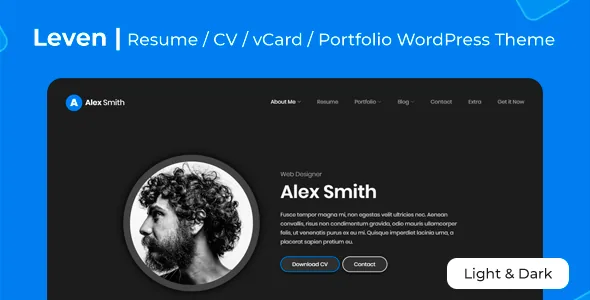
Most personal-site themes give you pages and let you decide what a CV needs. LMPixels' feature list for Leven goes the other way and names the CV parts: Resume on the Timeline, Skills with percentages and a colour control for each bar, a Certificates section, an Availability calendar, a Pricing section and two designs for Services Blocks.
That set is a small publishing vocabulary rather than a pile of extras. A timeline block holds the chronology a work history needs, so roles and dates sit in one vertical sequence instead of loose paragraphs. Per-skill bar colour means competencies read as a chart rather than a bulleted list. Certificates and service blocks cover the credentials and offerings freelancers usually format by hand.
The availability calendar is the entry that most shapes expectations. It implies visitors check when you can be booked, which fits a consultant, photographer or designer working to a schedule. The vendor lists a separate Calendar item too, so the shortcode set appears to cover general date content as well as bookable availability.
A short bio page does not need any of this. A site that publishes work history, a skills profile and bookable dates uses it immediately.
Light and dark versions, and the switches that quieten the motion
The presentation layer is what makes a Leven page recognisable at a glance: the vendor describes six home page variants, light and dark versions, and seven page transition animations.
That layer was built over several releases. Version 1.3.0 added the dark version and two new demos. Version 1.1.0 added six animated page transitions on top of the ones already present, and introduced a third home page style with more design settings and the option of an image or video background, which the vendor maps to the About Me 3 to 6 demo pages.
The off switches matter as much as the effects. The vendor states that all theme animations can be disabled in the theme settings, and version 1.5.0 added a specific control for page transitions. Version 1.2.1 added a way to disable the animation effect on the home page image. So you are not choosing between a fully animated demo and a static theme: individual pieces can be dropped while the rest stays.
Version 1.1.0 also added the option to change the content area's border radius and to turn off its box shadow, which is the difference between a card sitting on the background and a flat panel.
The portfolio is not limited to still images
The vendor describes a filterable portfolio with AJAX-loaded project details that include navigation, plus a slider and a mobile-optimised lightbox. What separates it from a normal grid is the media claim: the portfolio grid and the project details are both said to support image, video and audio, with YouTube, Vimeo, Facebook video and SoundCloud named as sources.
For motion or sound work, that changes what a project page can be. One entry can open on its own video, point to a SoundCloud track, or lead with a still, without a separate template per type. Responsive YouTube, Vimeo and Facebook embeds are listed as a general feature too, so video is not confined to the portfolio.
Portfolio Masonry Grid is listed separately, giving you an uneven-column arrangement for mixed image shapes. Version 1.5.4 records a Load More improvement, and several 2022 releases touched portfolio PHP code, so the filtering and loading behaviour has been maintained after launch rather than left at its first state.
The listing does not say how many items a grid shows, how filters are defined, or whether one project can mix media types. Check those against your own content.
Where the page builder stops and the settings panel starts
Content is assembled in a drag-and-drop page builder that the vendor markets as not requiring CSS or HTML, and the same route is described for pages, portfolio projects and blog posts. Alongside it sit 37 shortcodes and a theme settings panel.
The split has practical weight. The builder decides what sits inside a page or post. The settings panel decides the layer around it: typography for headings, main menu and body text, page titles, unlimited colour schemes, and a pick from the 800+ Google fonts the vendor counts. Those global type and colour choices live in one place instead of being repeated per page.
The shortcodes carry the repeating section types, and later releases kept extending them. Version 6.0 turned columns into sliders with any content — a feature request that makes a static row rotate. Version 1.6.1 added a new map shortcode, and version 1.8.3 added custom captions to the image shortcode.
One structural limit to design around: the main menu is described as two levels. A navigation plan that needs a deeper hierarchy has to be simplified.
Three translation routes, and the one that is concrete
The vendor lists a built-in extension for multilingual sites, names WPML among the compatible plugins, and ships a .pot file. Those are three different mechanisms, and the description does not connect them or say which one the vendor recommends.
The .pot file is the most concrete item: it lets you translate the theme's own interface strings in a standard translation tool. WPML compatibility is an attribute-level declaration, and the built-in multilingual extension is a separate claim again. Nothing in the listing says whether demo content is translated out of the box or how many languages the demos cover.
For a bilingual CV site, plan to confirm the route on the demo and in the documentation rather than treating the extension and WPML as interchangeable. Bootstrap 4.x also appears in the attributes, which is a framework version declaration rather than something you configure.
The 1.8.0 framework change is the detail that affects older tutorials
Two package facts matter if you expect to modify anything. A child theme is included, so template overrides survive updates in the usual way. The ThemeForest file list names layered PNG sources beside PHP, HTML, CSS and JS files, which means design artwork is editable rather than only compiled output.
The consequential changelog entry is version 1.8.0, dated 28 November 2023: the Unyson framework was replaced by LMPixels frameworks, with the Leven shortcodes' PHP updated alongside. Anything written against Unyson-based versions — forum threads, older tutorials, settings walkthroughs — describes a structure that no longer applies. Settings locations and shortcode behaviour may have moved.
Later releases are maintenance plus small additions. Version 1.7.0 added a Blog Settings tab. Version 1.8.4 and 1.8.5 were style and framework PHP improvements, and 1.8.5 records compatibility work for PHP 8.3 and WordPress 7.0.
The declared WordPress range runs from 4.9.x through 7.1.x with Gutenberg Optimized marked Yes. That is a wide support statement, not a record of testing every combination, and it says nothing about your PHP version, plugins or host. The features described here come from the vendor's marketplace description and changelog; they describe what the theme is built to do rather than the results of an install.
Questions & answers
Can I keep one animation and disable another?
The vendor says all theme animations can be turned off in the theme settings, and version 1.5.0 added a dedicated switch for page transitions. Version 1.2.1 added a separate control for the home page image animation, so the motion layer is not a single all-or-nothing setting.
Does the portfolio handle video and audio as well as images?
The vendor states that both the portfolio grid and the AJAX project details support image, video and audio, naming YouTube, Vimeo, Facebook video and SoundCloud as sources, with a slider and a mobile-optimised lightbox. How each media type is assigned per project is not described in the listing.
Do I need WPML for a multilingual CV site?
Not necessarily. The vendor describes a built-in extension for multilingual sites, lists WPML as compatible, and includes a .pot file for translating the theme's strings. These are separate routes, and the listing does not say which the vendor recommends or whether demo content is translated.