A storefront assembled from shortcodes, not drawn in a builder
Elated's feature list for Konsept names two editor companions: Qi Addons for Elementor and Qi Blocks for Gutenberg. That pairing is why the theme suits teams that disagree about tools. A designer can lay out a home page in Elementor while a content editor keeps the blog and inner pages in the block editor, and both arrive at the same theme styling.
The more consequential detail is what sits underneath. The shop sections are not built from the editor's own widgets. They come from theme shortcodes: Product List, Product Categories List and Product Value Deal, plus a WooCommerce DropDown Cart widget for header or sidebar slots. A category row on the home page or a highlighted sale set is a shortcode you place and configure. Because shortcodes render on their own, which editor you chose for the surrounding page does not change how those modules behave.
Where demo pages sit still matters beyond the shop blocks. The seller's copy does not say which editor the demos were assembled in, and the marketplace lists Elementor and WPBakery Page Builder in its compatible-with attributes alongside a Yes on Gutenberg Optimized. If you plan to keep and extend a demo layout, open that demo first and check its structure rather than assuming it will open as native blocks or Elementor sections.
Swatches went from supported to required in version 1.8
Furniture is sold on finish and fabric, and the theme's answer is the QODE Variation Swatches for WooCommerce plugin. The changelog makes the relationship unusually clear: version 1.8, dated 9 July 2024, added the plugin as required and added compatibility with it in the same release. Earlier versions did not treat it as a dependency, so a site built today should expect the swatch plugin to be part of the setup rather than an optional add-on.
The seller also declares compatibility with the YITH Color and Label Variations add-on and with a Quick View and Wishlist add-on. Those are third-party plugins the theme says it works alongside; the listing does not describe them as bundled with Konsept, and it says nothing about how all three behave together on a product with many attributes. That is a question for your own catalogue data.
Portfolio pagination as a real choice, plus project single layouts
Interior businesses usually need two catalogues, products and completed work, and Konsept carries a full portfolio module for the second. Gallery and Masonry layouts are listed for the archive, with a Portfolio Category List shortcode for a filter rail, and portfolio single pages available as galleries, sliders, image sets and full-width image stacks.
The part worth deciding early is pagination. The seller offers three modes: standard pagination, a Load More button and infinite scroll. Numbered pages suit a fixed set of a dozen projects; Load More keeps the first screen short while letting a visitor pull in further room sets without leaving the page. Choose one before building the archive, because switching later changes how you think about project ordering and images per row.
Header behaviour and the two layout switches that set the tone
The seller lists five header types and three behaviours: sticky, sticky on scroll up, and fixed, with separate mobile header styling, multiple logo versions for mobile and sticky states, and dark and light logo variants. For a furniture shop the practical pairing is a minimal or transparent header over a large product photograph, then a persistent version that keeps the cart and search reachable on a long category page.
Two global switches do more to the site's character than any header setting. A boxed layout option constrains the design to a centred canvas. A separate passepartout border frames the whole website in margin, so the store reads like a printed catalogue page rather than a full-bleed image. Both affect edge-to-edge photography, so settle them before the page layouts are built around full-width hero images.
What the seller says about images, the slider and the package
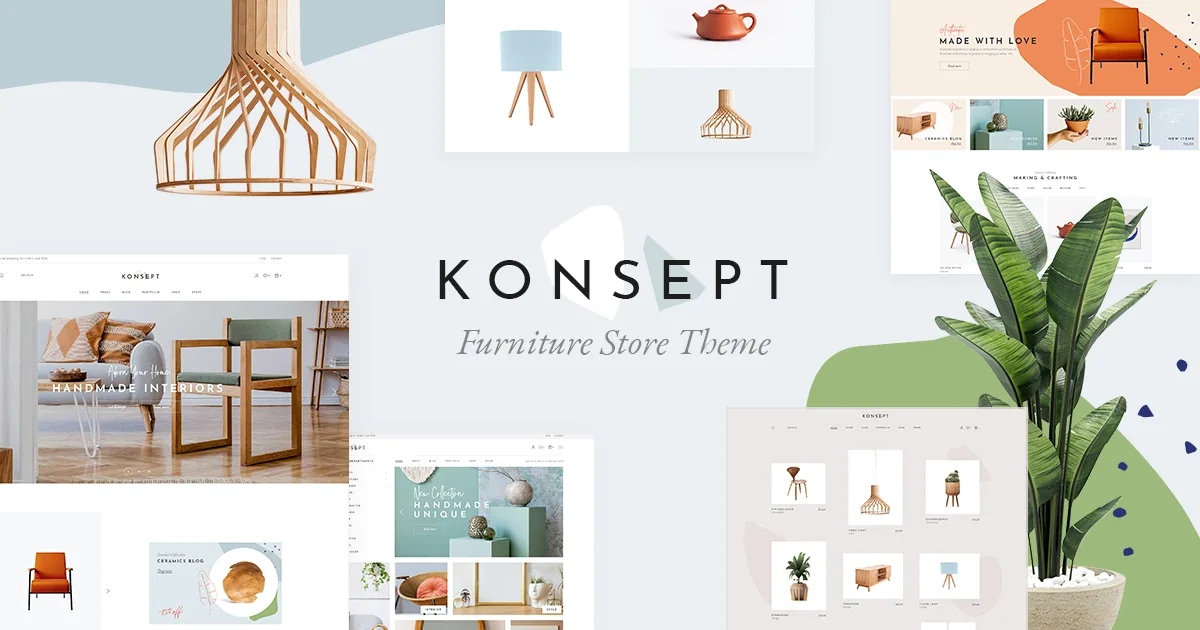
The description states that the demo photographs are presentational only and cannot be reused on your site without buying a stock licence yourself. For a theme whose appeal rests on interior photography, that is a line item in the budget rather than a footnote: plan on a licence or your own shoot instead of carrying the demo look forward.
The feature list also names Slider Revolution with a stated value of $109 and a child theme among the inclusions, while the marketplace file field lists PHP, CSS and JS files. Those two statements describe the same delivery from different angles, and only the seller's line makes the slider claim. Treat it as the vendor's statement about their package rather than as an assumption about any particular copy of the theme. The changelog mentions Revolution Slider updates across several releases, so the theme depends on that plugin rather than merely mentioning it.
Versions, declarations and what they do not establish
The marketplace records version 2.0 as the latest release, with a changelog entry dated 18 March 2026 covering a Revolution Slider update, Konsept Core 1.4, a WPML config change, font helper and pagination helper improvements, a WooCommerce figure CSS selector fix and a fix for adding custom fonts. The entries before it show the theme being kept in step with WordPress and WooCommerce releases, plus a PHP 8.3 compatibility improvement in version 1.9.
Attributes observed on 5 November 2026 declare WordPress 6.3.x through 7.0.x, WooCommerce 9.x.x and 10.x.x, WPML, Contact Form 7, and Firefox, Safari, Opera, Chrome and Edge. Those declarations describe the current marketplace release and the vendor's testing claim; they are not a result from your PHP version, caching layer or plugin set. If your stack differs from that range, confirm behaviour on a staging copy before committing the build.
Questions & answers
Do I have to build the pages in Elementor?
No. The seller lists Qi Addons for Elementor and Qi Blocks for Gutenberg as compatible companions, and the marketplace marks Gutenberg Optimized as Yes while also listing Elementor and WPBakery Page Builder. Only the demos' own structure would settle which editor they were authored in, and the listing does not say.
Is the variation swatch plugin optional?
As of version 1.8 the seller added QODE Variation Swatches for WooCommerce as a required plugin, so treat it as part of the setup rather than an add-on you can skip. The listing does not explain how the plugin is supplied alongside the theme.
How many products can the Product List shortcode show?
The seller describes the shortcode and the shop layouts it supports but publishes no limit, column count or filter configuration detail. Set the expected catalogue size against the demo instead of assuming a ceiling.
Can I reuse the demo photography?
The seller says the demo images are licensed for presentation only and cannot be used on your site without buying a stock licence yourself.