The page is a canvas you move across, not a page you scroll
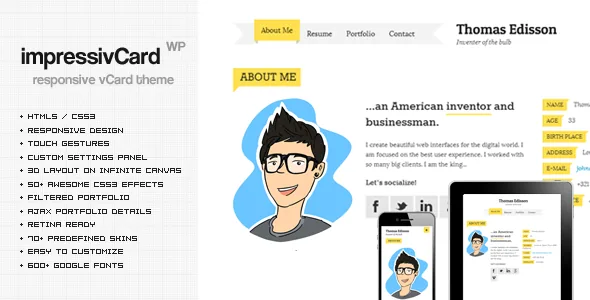
The vendor describes impressivCard WP as a 3D jmpress layout built on an infinite canvas with CSS3 animations. That is the product's organising idea: sections sit in space and the visitor travels between them rather than scrolling down a column. If you want a vCard that feels like a small navigable scene, that is the reason to open this theme at all.
The same description treats the layout as a setting rather than a fixed identity. A classic layout takes over in browsers that cannot handle the 3D mode, and the listing offers an option to disable the 3D layout permanently. That switch matters even if you like the effect: it lets you keep the theme's portfolio, skin and font system while presenting an ordinary page, and it gives you a fallback position if the animation model stops suiting you.
Deep linking is what keeps non-linear navigation usable
A single canvas with several panels creates an obvious problem: how does a visitor return to the panel they just left? The vendor states full browser back-button support with deep linking, which means individual views inside the theme can carry their own address and respond to the browser's history controls in the usual way.
For a personal vCard this is the detail that separates a workable interface from a gimmick. Someone who clicks from profile to portfolio to contact and then presses back expects to land where they were. The marketing copy asserts this behaviour; it is not something the description shows in detail, so treat back-button and link-sharing behaviour as the first thing you check on the vendor demo.
Portfolio details are loaded without leaving the canvas
The portfolio is described as a filtered grid whose item details open through ajax. In a compass-style layout that choice makes sense: opening a project in an overlay keeps the visitor on the canvas instead of pushing them into a full page and breaking the spatial feel.
The vendor's lightbox is custom-styled for mobile and accepts both images and video. It also lists more than 50 CSS3 in-and-out animation effects for portfolio items. That is a lot of motion for a small site, and the number is a self-reported inventory rather than a quality measure. Filtering plus ajax details is the practical core; the animation count is the part you would tune down or ignore.
Skins, fonts and a settings panel do the appearance work
There is no page builder in the described workflow. Appearance is handled by the theme's own custom settings panel, and the vendor lists 70 predefined styles with unlimited colour control, more than 20 social icons, 600+ Google Fonts and a Google Maps-ready setup. For a one-person card, that is a reasonable trade: fixed layout, many colour and type variations.
The changelog supports the picture of where effort went. Across versions 3.6.x to 3.7.1 the recorded changes are improvements to theme options, widgets, comments, archives, search and localization, plus a fix for 3D animations in Firefox. A shortcode generator arrived back in version 2.0. Nothing in that list suggests a visual page-building layer.
Support ended in 2015, and the listing says so
The description opens with a note: this theme will no longer be supported starting from 1 April 2015. The changelog's final entry is version 3.7.1, dated 20 August 2015, and the marketplace entry carries the same version number.
That sets the practical question. A vCard is small and mostly static, so a theme that has stopped moving can still present a profile, a portfolio and a contact route. But you cannot rely on vendor help, and the marketplace's declared WordPress range (6.0.x through 6.5.x, as observed on 5 November 2026) is a compatibility statement rather than evidence that anyone has run this release on a current install. Two smaller signals point the same way: the browser list still includes IE8 through IE11, and Gutenberg Optimized is marked No, which says the theme was never adapted to block-editor authoring. Neither proves the block editor is unusable for ordinary posts, and neither is a defect in a theme of this age — they simply date it.
What this theme is actually good for
Take impressivCard WP when the interaction is the point: a freelancer, designer or photographer who wants a compact personal site that behaves like a small 3D space, with a portfolio that opens in place and a colour scheme picked from many presets. The classic fallback makes that a safer bet than it sounds, because the theme can be presented conventionally.
Skip it when you need a site you will keep extending. There is no page-builder route described, no block-editor optimisation and no vendor support since 2015. The package file list mentions PHP, CSS and JS files, which is enough if you plan to work in the theme's own templates and stylesheets. Whether an old, small vCard theme is the right foundation is a question about your appetite for maintaining it yourself, not about how many skins it has.
Questions & answers
Can I use impressivCard WP without the 3D effect?
The vendor says yes. The description offers a classic layout for browsers that do not support the 3D mode and an option to disable the 3D layout permanently, so the theme can be presented as a conventional page.
Does impressivCard WP include a page builder?
The vendor description does not name one. Layout and colour are handled through a custom settings panel, 70 predefined styles, unlimited colour options and a Google Fonts library, and the Gutenberg Optimized attribute is marked No.
Is the theme still updated or supported?
The vendor states that support ended on 1 April 2015, and the changelog stops at version 3.7.1 dated 20 August 2015. Any compatibility claim, including the declared WordPress 6.x range, is a marketplace statement rather than evidence of recent testing.