The transitions are the design decision, not a footnote
Most themes list animation as a checkbox near the bottom. Empathy puts it near the top: the vendor names "67 Different Page in-out animations," which is a large set for a personal site. That is the fact that should decide whether you open the theme at all, because it changes how every navigation between pages feels. A visitor clicking from work to contact sees the page leave and arrive in a chosen manner, every time.
A vCard site is a short journey — usually home, a few pieces of work, a note or two, contact. Motion can carry that kind of site in a way it cannot carry a content archive, because the same repeated transition never has time to feel routine. The counterweight is that 67 options is also 67 ways to get it wrong for your subject. A photographer can afford something theatrical; a consultant with a compliance-heavy client base should probably pick the quietest option available.
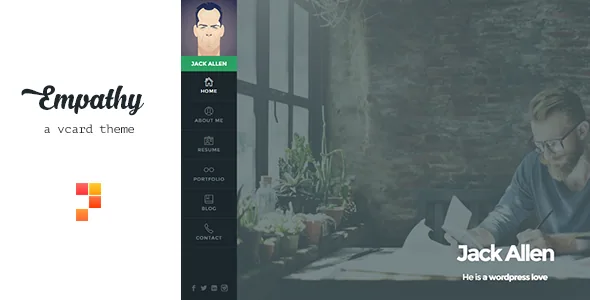
The rest of the vendor's feature list is organised around that single-identity premise: the description calls the theme a way of "representing your online identity," and the marketplace files it under creative/portfolio.
Portfolio details that load in place, with sound and motion inside them
The portfolio is described as filtered, with detail views delivered over ajax and a "custom styled-mobile optimized lightbox." Both the detail views and the lightbox are said to accept image, video and audio. Read that as a content allowance rather than a layout feature: a project entry can present a recording, a soundtrack or a clip, not only a still image.
Filtering plus in-place detail loading keeps the visitor on one screen while narrowing and opening work. If you have eight projects and a visitor only cares about two of them, that combination is the difference between browsing and clicking through a stack of separate pages.
Two practical limits are worth knowing before you build around this. The description does not say how the media files are attached — whether they are chosen inside the portfolio item itself or embedded in the item's content — so plan on checking that with one real project rather than assuming. And the lightbox is described as mobile-optimised by the vendor; that is a claim, not a measurement, so open a heavy video item on a phone before you commit to video-led case studies. The vendor separately lists responsive video embeds in various aspect ratios, which suggests video is treated as deliberate content rather than an edge case.
Where you actually change the design
There is no page builder in the vendor's description. Styling runs through the WordPress Theme Customizer for fonts and colours, alongside a separate custom settings panel, with 600+ Google Fonts available. Treat the Customizer as the place you make global decisions — typeface, palette, and whatever else the settings panel exposes — rather than the place you compose pages.
The listing marks Gutenberg Optimized as No. That attribute describes the vendor's own design and presentation work; it does not by itself establish that the block editor is switched off or broken. What it does tell you is that the theme's page layouts were designed around its own templates, so if your publishing routine depends on assembling pages from blocks with fine visual control, try that on a test install before you plan a content model around it.
The stated intent behind these controls is speed: the vendor describes tuning the theme to your style "in minutes with no hassle." That is a claim about the settings, and the honest way to test it is to see whether the demo's proportions hold up once you change the font and two colours, not only whether the options exist.
Writing, social feeds and a second language
Empathy is not presentation-only. The vendor describes a complete blog system with all post formats supported, so notes, links and quick media posts each get their own treatment rather than being flattened into a standard article. For a personal site where the writing is part of the point, that is the difference between a portfolio with a news page and an identity site that actually publishes.
On the identity side, the vendor bundles custom widgets for Flickr, Instagram, Pinterest, Dribbble, Picasa and YouTube. These pull your existing off-site activity into widget-ready areas, which is the practical reason a vCard theme beats a static page — the site can act as the hub while the feeds keep themselves current. The description does not explain how each feed is authenticated or how frequently it refreshes. If a live Instagram or Dribbble stream is central to the plan — and Pinterest in particular has changed its access rules over the years — confirm the widget still populates in the demo before designing around it.
Translation is also declared: the theme is described as translation ready with a .po file included, and WPML is listed as compatible. This is a young theme in marketplace terms relative to its last recorded update, so the cautious reading is that the .po file covers the theme's own strings and that anything added later, including Customizer labels, may need checking with your second language in place.
Declared compatibility against a two-year-old update record
When the listing was observed on 4 November 2026, the recorded attributes named WordPress 6.5.x through 6.9.x, WPML, responsive layout with 4+ columns, widget-ready areas, high-resolution support, and browsers including Chrome, Firefox, Safari, Opera, Edge and IE11. The packaged files are listed as PHP, CSS and JS. These are vendor and marketplace declarations attached to the listing, not results from running the theme on your server.
The figure to weigh alongside them is the recorded last vendor update: 21 April 2022. That is roughly four and a half years before the observation date, sitting next to a compatibility list that reaches WordPress 6.9.x. The two are not automatically in conflict — version attributes on a listing can be revised without a new theme release — but nothing in the evidence shows a release, a tested changelog entry or a maintenance statement covering that gap. So treat the declared versions as a starting point to verify, particularly on a recent PHP release or with plugins that hook into theme output.
The IE11 entry points the same direction as the date. It is harmless in itself, and it suggests a front end built when cross-browser fallbacks were standard practice — useful context if you are judging how recent the underlying code patterns are likely to be.
Starting from the demo import
One-Click Demo Import is listed, which is the fastest way to see the theme with content in it rather than empty. Two things shape what you should expect from that import. The credits attribute the avatar illustration to Stanley Chow, and preview artwork is generally not part of a theme package — so plan on replacing imagery immediately if you want to judge spacing and typography honestly.
A short, specific test is more informative than a broad one: import the demo, open one portfolio project with a video and one with audio, run a page transition on a phone, then switch the font and a colour in the Customizer. That sequence exercises the three claims the vendor leans on — media-capable portfolio, motion, and Customizer styling — and will show you fairly quickly whether Empathy fits the site you have in mind.
Questions & answers
Does Empathy ship with a page builder?
None is named in the vendor's description. Customisation is described as running through the WordPress Theme Customizer plus a custom settings panel, and the marketplace marks Gutenberg Optimized as No. That marking concerns the vendor's own design and presentation work rather than proving the block editor is unusable, so test block-based pages on your own install if that workflow matters to you.
Can a portfolio project be a video or an audio piece rather than an image?
According to the vendor, yes. Both the ajax portfolio detail views and the mobile-optimised lightbox are described as supporting image, video and audio, and responsive video embeds in various aspect ratios are listed separately under flexible images and videos. How media is attached to an individual project is not detailed, so verify it with one real project.
How much can I change without touching code?
Fonts and colours are handled in the WordPress Customizer, with 600+ Google Fonts available, and a separate custom settings panel is listed. The description does not say how far those settings reach into individual templates versus global styles, so check spacing and layout behaviour in the demo before assuming per-template control.
Is the theme current?
The listing declared WordPress 6.5.x through 6.9.x and WPML compatibility when observed on 4 November 2026, while the recorded last vendor update is 21 April 2022. Nothing in the evidence documents testing between those dates, so confirm behaviour on your own PHP version and plugin set rather than treating the version list as proof of recent maintenance.