Layouts for the pages an agency site actually runs
RadiusTheme's feature list for Digeco is specific about the content types an agency repeats: 8 team layouts split into 4 grid and 4 slider variants, 16 portfolio layouts, and 2 service layouts covering grid, slider and tab arrangements. Those numbers describe templates for listing people, work and services — the pages you rebuild every time a client is added or a project ships.
That matters more than a homepage count once the site is live. A slider team layout gives you a horizontal roster in a narrow section, while a grid suits a team of eight where everyone should be visible at once. Portfolio layouts offer grid, isotope and masonry arrangements, which changes whether category filtering helps on a page of twelve projects or reads as clutter on a page of four. Digeco does not add archive pages for everything up front: the vendor's changelog records a team archive page arriving only in version 1.7.2.
The portfolio count in the source is internally muddled. The summary text says 7 portfolio designs, while the feature list says 16 layouts and then enumerates three grid, two isotope and two masonry entries. Treat the exact figure as unconfirmed and match the layouts you need against the live demo instead.
Headers and footers: two counts that don't agree
The vendor's feature list states 7 header styles that can produce 20+ variations, plus 9 footer styles. The prose description introduces the same subject as “4 header styles (with 10+ variation options) and 4 header styles”, repeating the phrase where footer was presumably meant. Both sentences come from the same marketplace description, so neither can be called authoritative over the other.
The practical reading is that Digeco supports several header compositions with configuration on top — a transparent header over a hero, a sticky bar, a centered logo — and several footer arrangements. Whether the variation you want exists is a question for the demo preview rather than the count. The listing also records the theme as widget ready, so footer columns can be filled from widget areas instead of being hard-coded into the template.
The demo importer covers four home pages, not thirty-one
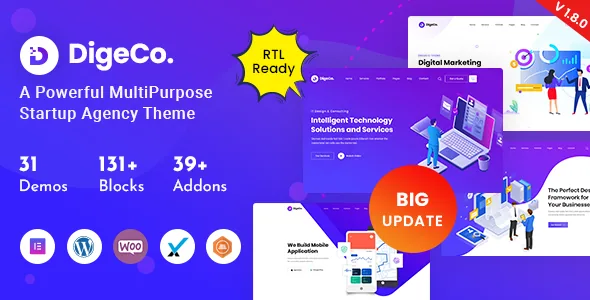
Digeco advertises 16 multi-page homepages and 15 one-page homepages. The same feature list names a one-click demo importer for 4 home pages. Read together, the importer seeds a working site from a small subset of the layouts, and the remaining home designs work as references you rebuild in Elementor.
For a project with a fixed launch date that changes the plan. Import a demo as the starting structure — menus, widgets, sample content, theme settings — then compose the real homepage. If you were expecting thirty-one one-click starting points, the import step will feel narrower than the page count suggests.
Changelog entries back this up. Version 2.2.0 added two home pages (Project Management and Business Agency) and updated the demo importer in the same release, while 1.8.0 added three home pages without mentioning the importer.
Elementor for pages, Redux for the shell, a child theme for edits
Page building runs on Elementor, which the vendor describes as bundled and drag-and-drop. Theme-level settings sit in a Redux admin panel, listed separately from the WordPress Customizer, so colour and typography choices made inside Elementor widgets and choices made in the options panel are two different places — worth knowing before you build a colour system. The theme also lists unlimited colour combinations and a customizer for theme-option changes.
The vendor includes a child theme and presents it as a way to modify Digeco without losing earlier versions of the site. That is the usual argument for one: parent-theme updates overwrite parent files, so customised templates and CSS placed in the child survive.
The front end is described as Bootstrap 4.x compatible, and package contents are listed as PHP, CSS and JS files. Slider Revolution appears in nearly every changelog entry from 1.6.1 onward, most recently alongside the Digeco Core plugin in 2.2.6, which suggests a maintained dependency rather than a one-off inclusion.
Translation, RTL and the features that arrived later
WPML is the named translation plugin, with a pot file listed for the theme's own strings, so interface text can be translated independently of the content you write. The changelog shows RTL support arriving in version 1.3 alongside a new Digital Agency homepage, and version 1.7.4 fixing RTL compatibility and the mobile menu.
A theme released in 2020 and still shipping fixes in 2026 accumulates features gradually, which is normal. It does mean the archive templates for team and service content may not behave as the demo suggests if you inherit an older copy, and that right-to-left layouts deserve a look if Arabic or Hebrew is on the roadmap. The marketplace attributes capture compatibility statements, not results from running the theme on a specific server.
Demo images, fonts and where WooCommerce sits
The vendor states plainly that premium images are not included and appear for demonstration only. Imported demo pages therefore arrive with photography you must replace or license separately — a budget line rather than a technical problem. Fonts are Google fonts (Poppins and Roboto), not bundled commercial type.
WooCommerce support is a changelog fact rather than a headline feature. Version 1.4 added it, and later entries repaired outdated WooCommerce files, including 2.2.2. That says the theme has carried commerce compatibility for years, but the feature list describes no shop layouts, so do not assume a styled storefront beyond what standard templates give you.
Questions & answers
Does Digeco require Elementor to build pages?
The vendor lists Elementor as the drag-and-drop builder included with the theme, and the demo pages are authored for it. The marketplace description does not outline a non-Elementor route for those layouts, so plan on installing Elementor.
Can I use the demo photography on a live site?
Not as shipped. The vendor notes that premium images are included for demo purposes only and are not part of the theme package. Replace them with licensed images or your own before launch.
How many home pages can I import with one click?
Four, according to the feature list, against the 16 multi-page and 15 one-page homepages advertised. The other home designs serve as references to rebuild in Elementor rather than one-click imports.