Two editing surfaces: archives in the theme options, homepages in BKNinja Composer
Ceris splits page work across two places, and knowing which one owns what saves confusion later.
The vendor describes a Category Options group that configures archives rather than the front page: 15 category layouts with individual options, 4 layouts for the featured area above the listing, a sidebar you can move left or right, sticky sidebar on or off, unlimited category colours with featured-image settings, and pagination choices per category. Building a news, reviews or sport section differently is therefore a settings task in the theme rather than a template-building task.
Homepages go the other way. The vendor says the theme integrates with the BKNinja Composer plugin, described as a drag-and-drop page builder and fast editor where you select modules and drop them into sections, combining them as you like. The listing also advertises 43+ complete demo homepages with one-click import. Treat that number as breadth of starting points: a module library gives you parts, and each assembled front page is still a composition of those parts.
One detail belongs with the theme rather than the builder: the listing marks Ceris as Gutenberg Optimized: Yes, and the changelog records Gutenberg fixes, including a PHP 7.4.8 issue in 1.9.
What the three pagination modes change for a reader
The category pagination list is short — Ajax Load More, Ajax Pagination, and default WordPress pagination — but each produces a different reading experience.
Load More appends the next entries under the current set, which suits a browsing reader who stays in one scroll. Ajax Pagination replaces the page of results without a full reload, closer to flipping through a paginated archive. Default WordPress pagination is the plain page-number path.
The vendor also lists Ajax Load Posts as a separate feature for loading further posts without reloading the page, so the no-reload behaviour is not confined to archives.
Whether a single site can hold different modes on different categories at once is not stated. If you plan a mixed setup, set two categories side by side and check.
Reader tools that operate on the article list
Several listed features change what a visitor can do with a list of articles, not how it looks.
Bookmark Articles lets a reader save items from a list. Dismiss Articles lets them remove items from that list. On a long magazine archive, that pair turns browsing into something a returning reader can manage rather than re-scan.
Login is handled inside the theme: Ajax Login with Social Login keeps sign-in off the WordPress login screen, which matters if a login step sits in front of paid content. The Paywall feature, added in version 4.6.2, is described as monetising content through subscriptions and article purchases.
For review sections, the Integrated Review System adds a summary with Pros and Cons lists to a post. Around that sit 9 header types with a togglable sticky header, a Mega Menu that shows posts inside a category menu item, and a Custom Sidebar Generator for unlimited sidebars.
The AI chatbot and writing assistant come with a credits arrangement
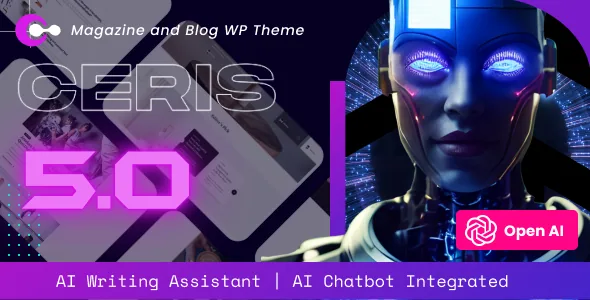
The changelog records AI Chatbot ChatGPT and AI Writing Assistant as version 5.0 additions, with 5.2 adding more models, a Lio endpoint and chatbot performance work, and 5.3.1 fixing a writing-assistant icon issue.
The vendor's own copy also offers 30% to 50% off when you purchase AI credits. That single line is the practical detail: the AI side is not a self-contained theme feature running on your server, and a credits arrangement sits behind it. The changelog pattern — new endpoints and models across point releases — suggests an integration that keeps changing.
If AI assistance is part of an editorial plan rather than a curiosity, confirm the current credits terms and behaviour directly instead of assuming the 5.0 feature set stands unchanged.
Declared versions, files, and where the risk sits
The marketplace attributes, observed on 4 November 2026, list WordPress 5.7.x through 7.1.x and WooCommerce 8.x.x and 9.x.x, with browsers including IE11, Firefox, Safari, Opera, Chrome and Edge. Included files are PHP, CSS and JS. The vendor also advertises AMP support, a translation-ready .pot file, GDPR compliance, ad placement and affiliate integration, and bundled related and same-category posts.
These are declarations, not test results. A support range that reaches back to WordPress 5.7.x while the theme ships an AI chatbot and a paywall is wide enough that a staging install on your own versions is worth the hour. The AI and paywall layers carry the most uncertainty because they lean on services and configuration outside the theme; the category options are plain theme settings and the least likely to surprise you.
Questions & answers
Can two Ceris categories use different pagination modes at the same time?
The vendor lists pagination among the per-category options with three modes available, but does not say whether different categories can hold different modes simultaneously. Test that specific case before you plan around it.
Do the AI writing assistant and chatbot need a separate purchase?
The vendor description offers a discount on AI credits, which indicates the AI features depend on a paid credits arrangement rather than running independently. Confirm the current terms before building a workflow on them.
Are the 43+ demos a single layout that updates everywhere?
No. The vendor describes demos as pre-designed pages imported in one click and pages as compositions of BKNinja Composer modules. Each front page is its own assembly, so plan to build section front pages rather than assume one setting propagates across all demos.