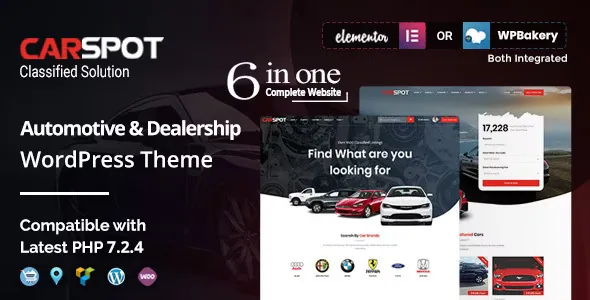
The ads economy comes before the design
CarSpot's vendor description spends its energy on what happens to a listing, not on how a homepage looks. Three separate items in the feature list set the business model: front-end listing submission, pricing plans available in both paid and free form, and membership plans. A visitor can post a vehicle themselves instead of sending it to an administrator, and the theme is built to charge for that in tiers.
Promotion is handled at the ad level. Bump Up Ads sits in the same sentence as comparison, search filter and the review system, and the listing also names category-based pricing and an on/off switch for featured ads. Read together, that means a listing has a position in a category, a price attached to its category, and an optional paid push. If your plan for the site involves sellers paying for visibility, these are the settings that decide whether it works, not the demo styling.
One thing to check before committing: the description says six premade demo designs, while the WordPress theme metadata mentions 11 home variations. Both come from the same vendor, so treat the count as unresolved and judge the demos on the live preview rather than the number.
Bidding as a second path to an enquiry
A classified site normally ends in a phone call or a message. CarSpot adds an auction-style route on top, and the changelog is more informative about it than the feature list. Version 2.3.6 introduced a minimum bid field and a bid difference field as theme options, plus a bidding timer and email notifications for the first bid and the highest bid. Version 2.3.7 extended the module with maximum bids and a minimum bid shown inside the text field.
Those details matter because they describe rules you set, not a fixed auction mechanic. A bid floor stops low offers, an increment keeps bids from creeping up by trivial amounts, and a timer closes the window. The two emails keep the seller informed without them refreshing the page.
If you sell cars at fixed prices, the module can presumably stay out of the way, though the supplied material does not say whether it can be disabled per listing or only site-wide. That is worth confirming on a staging install before you promise auctions to sellers.
How a buyer narrows the lot
Search is described with more specificity than most theme feature lists manage. Location-based search and radius search with Google sit beside category-based search and live search with suggestions, and car comparison is listed as its own feature. The combination shapes the browsing experience: a shopper can start from a place and a distance, or from a vehicle category, or by typing and taking a suggestion.
The radius and location tools depend on Google Maps, and the vendor has added a visible warning that Google updated its Maps service policy. That is a planning item rather than a footnote, because API keys and billing arrangements for Maps are handled outside the theme. Check the current policy terms before you build a search experience that leans on the map.
Comparison is the quieter feature. A comparison view lets a buyer hold several vehicles side by side instead of opening tabs, which is the kind of thing that shortens a shortlist. The supplied evidence lists it as a feature but does not describe how many vehicles can be compared at once, so treat that as unverified.
The moderation layer that keeps a classified site usable
Open submissions bring mess, and CarSpot's feature list includes a set of controls aimed at it. Seller rating and seller badges appear as features, and version 2.4.2 of the changelog added a user profile badge option. A watermark can be applied to ad images. A bad word filter is listed among the ad features. Two communication modes are named, alongside a complete messaging module.
That cluster is the difference between a listing directory and a site you can leave running. Badges give repeat sellers a visible track record, watermarking discourages image reuse, and the filter saves you from reading every ad before it goes live. The changelog also records that the show-phone-number control and the WhatsApp button were moved to AJAX in version 2.4.5, which affects how those contact details are exposed on a listing page.
Messaging is where the two communication modes need interpretation. The evidence does not spell out which two modes they are, so if a specific contact route is central to your plan, check it on the demo rather than assuming.
Six identities, one engine, and a per-category form builder
The vendor names the demo set as CarSpot, BikeSpot, ShopSpot, BoatSpot, Classispot and Repairspot, described as six designs for different business natures. The pattern is reuse: the same ad and search machinery is pointed at motorbikes, boats, shops, classic cars and repair services. For anyone running more than one vehicle vertical, that is a more interesting claim than the demo count itself.
The structural piece underneath is category-based form fields. Version 2.4.5 of the changelog added media upload custom field support to classified-ad category templates, which means a category's submission form can be extended with fields of your own choosing. A boat listing and a repair-service listing rarely need the same attributes, and this is how the theme accommodates that without separate templates.
The feature list also mentions creating custom ad types and related taxonomies. Those are configuration decisions rather than page-building ones: deciding your categories and their fields early saves rework later, and it shapes what the search filters can actually offer.
Two builders, with WPBakery named as the included one
Editing is split. The feature list names the WPBakery Page Builder as included, with its own $33 valuation, alongside "Elementor Page builder Added." The changelog shows where the recent effort went: version 2.4.5 rebuilt the Hero Section and Hero Search Form widgets in Elementor. Marketplace attributes, observed on 4 November 2026, mark Gutenberg Optimized as Yes and list Elementor and Elementor Pro among compatible items.
So the hero and the search form have Elementor equivalents as of the 2025 release, while WPBakery remains the builder the vendor singles out as bundled. If your team already works in Elementor, the practical question is whether every demo layout and widget you need has made the crossing; the changelog shows two widgets rebuilt, not a wholesale port.
The same attributes declare WooCommerce 5.x through 9.x, WPML and WordPress 5.6 through 6.9. Those are listing declarations, not install results. WPML matters more than usual here, because the changelog records a specific fix for translating category-based custom fields in version 2.4.0 — a sign that multilingual vehicle attributes have needed attention.
What the update record and the small print tell you
The changelog runs to version 2.4.6 on 1 January 2026, with security fixes and updated plugins. The preceding entries show a similar pattern of bundled-plugin updates, styling corrections and user-reported fixes, alongside feature additions like the car inspection module in 2.3.8 and the bidding work in 2.3.6 and 2.3.7.
Two vendor statements deserve space in your planning. The first is a support exclusion: the vendor states it does not provide support for adult or dating sites and asks buyers not to expect support for illegal, dating or adult websites. The second is the image disclaimer — the demo photographs are for demonstration only, so every car, boat and workshop image has to be replaced with something you are licensed to use. On a site whose value is largely photographic, that is a real line item.
Marketplace figures observed on 4 November 2026 recorded the theme at a 4.56 rating across 126 ratings and 1,723 sales, with a marketplace price of $59 for the Regular License. Those describe the listing at that moment, not what any particular copy contains; the theme files themselves are declared as PHP, CSS and JS.
Questions & answers
Does CarSpot let visitors post their own vehicle listings?
Yes, front-end listing submission is listed as a theme feature, and the changelog records fixes to front-end ad posting in version 2.4.1. Sellers can also be charged through the free and paid pricing plans and membership plans the vendor lists. The supplied material does not state the default moderation setting, so decide whether new ads publish immediately or wait for approval on your own install.
Can bidding and featured ads be switched off if I only sell at fixed prices?
Featured ads have a documented on/off option in the theme settings. The bidding module's rules — minimum bid, bid difference, timer — are configurable, but the evidence does not say whether it can be disabled site-wide or per listing. Confirm that before relying on the theme for a straight fixed-price dealership.
Does the theme work for boats, bikes or repair shops?
The vendor presents six demo identities: CarSpot, BikeSpot, ShopSpot, BoatSpot, Classispot and Repairspot. Because category-based form fields let each category carry its own submission fields, the same ad engine can present a boat listing differently from a repair-service listing. Note that the demo count is inconsistent in the vendor's own material — six designs in the description, 11 home variations in the theme metadata.