Page layouts are picked in the Customizer, not built from scratch
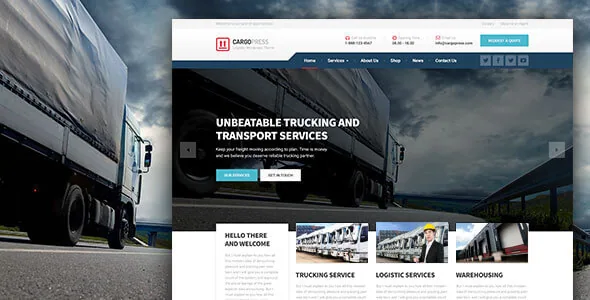
ProteusThemes describes CargoPress as shipping "many different page layouts" that you switch through the Customizer, and names the ones that matter for this kind of site: front page layout, regular page, shop, blog and more. That is a structural decision made in one global place, ahead of any page-level design work.
For a freight, trucking or warehouse business, the front page carries the heavy lifting — services, coverage, a quote or contact route — while the shop and blog layouts matter if you sell handling services or publish industry updates. Having them defined as layout choices means the shell of each page type is settled before you start filling it, and the live-preview Customizer lets you see the change before pushing it. The vendor does not state how many layout variants ship, so treat the count as something you confirm in the demo.
The page builder handles composition inside those layouts
CargoPress includes its own drag-and-drop page builder, described by the vendor as the tool that "does all the heavy lifting" when creating pages. The division of labour is straightforward: the Customizer sets site-wide structure and the builder arranges content within a page.
That split matters when a project gets handed over. Changes to typography, layout selection and shop behaviour stay in one place instead of being scattered through individual pages, while the builder stays where content editors expect it. The theme's marketplace attributes also record it as Gutenberg Optimized, so the block editor is a declared part of the picture rather than something the listing rules out. What the description does not say is how the theme builder's elements compare with core blocks — if your team works in the block editor already, check that on the demo before committing.
The vendor sells restraint, and that shapes the audience
CargoPress's own pitch lists "no annoying animations, just smart, simple design" among the reasons to choose it. Paired with a responsive, retina-ready layout, that reads as a theme aimed at companies who want a site that reads quickly on a phone in a depot or a warehouse office, not one that shows off motion.
It is a real constraint on the site, not a limitation to work around. A haulage site's visitor usually wants a service list, a coverage area and a way to make contact in a handful of seconds. A theme that leaves animation out of the default vocabulary means fewer settings to tune and fewer ways for a page to feel out of step with the rest — and fewer things to fix when a client asks why the home page animates differently from an inner page.
Multilingual: WPML, a named language set, and automatic RTL
The marketplace compatibility field lists WPML, and the vendor says the plugin can be configured for CargoPress "in minutes" with every theme translation-ready. Beyond that, the description names a specific set of languages the theme ships copy for: Dutch, French, German, Italian, Polish, Portuguese, Russian, Spanish and Slovenian.
That list is well matched to freight and cross-border shipping work, where a national operator often needs one or two second languages rather than a dozen. If your language is outside the set, translation readiness still applies, but you would be supplying the strings.
RTL support is handled by detection rather than a toggle: the vendor states that right-to-left text direction activates automatically when the theme finds WordPress installed in an RTL language. That is convenient for a single-site install and worth verifying if you run WPML with one RTL and one LTR language on the same site, since automatic detection is described at install level rather than per language.
Commerce and the plugins the vendor names
WooCommerce is described as fully integrated, so the shop layout referenced in the Customizer is backed by an actual storefront rather than styling alone. That suits logistics businesses that sell add-on services or handling products alongside their main operation.
Separately, the vendor says CargoPress supports popular plugins "by default" and names Contact Form 7, Custom Sidebars, Jetpack and Simple Lightbox. These are support declarations, not bundled code: Custom Sidebars lets you vary widget areas per page type, which is useful when a service page needs a different sidebar from a blog post, and Contact Form 7 covers the quote-request forms this industry runs on. Treat the list as what the theme has been built to accommodate, and confirm your own versions against the demo or a staging install.
Widgets, files and the imagery caveat
The marketplace records the theme as widget-ready with 4+ columns, and the vendor points to custom widgets and sidebars for building layouts. The included-files field lists PHP, CSS and JS along with a Layered PSD — useful if you or a designer need to adapt a graphic outside the browser, and unusual enough to be worth noting for a business theme.
The practical caveat is imagery. The vendor states plainly that the demo images are copyrighted, and that they arrive blurry inside the demo content. So the imported demo gives you layout and spacing, not publishable photography. Budget for licensed truck, cargo and warehouse visuals, or for your own fleet and facility photos, before the site goes near a client.
The declared versions, and what they do not tell you
As listed in November 2026, the marketplace attributes declare WordPress support from 6.2.x through 7.0.x, with the theme built on the Underscores framework and a marketplace version of 2.2.1. Browsers named are Firefox, Safari, Opera, Chrome and Edge.
Those are declarations about supported ranges, not results from running the theme against your WordPress build, your plugin set and your server. CargoPress carries a bundled page builder and expects WooCommerce and WPML to sit alongside it, so the combination you actually deploy is the one worth testing. Set it up on staging with those plugins active before you move it to the live site.
Questions & answers
Does CargoPress work with the block editor?
The marketplace attribute records Gutenberg Optimized as Yes, so the block editor is not excluded. The vendor's own description focuses on the theme's integrated drag-and-drop page builder and the Customizer instead, so decide whether your editors will use blocks or the theme builder before you build out pages.
Can I use the demo images on my own site?
No. The vendor states that the images shown in the demo are copyrighted and appear blurry in the demo content, which means the import shows layout, not licensed media. You need your own photography or properly licensed stock for the live site.
How does CargoPress handle a second language with WPML?
WPML is listed as compatible and the vendor says the theme is fully translation-ready, with copy provided for Dutch, French, German, Italian, Polish, Portuguese, Russian, Spanish and Slovenian. RTL direction is described as switching on automatically when WordPress is installed in an RTL language — verify how that behaves per language if you run both directions on one WPML install.